Illinois River Habitat Enhancement Project
Tailraces often lack suitable fish habitat due to reduced inputs of sediment
and woody debris coupled with frequent scouring flows. These habitat
deficiencies have significant impacts on fish populations and subsequent
management of tailrace fisheries. For example, reductions in usable area limits
the amount of productive stream for anglers because fish are concentrated in few
suitable areas. Fish movement and dispersion is also limited because necessary
habitat is not available throughout the stream continuum. The absence of
overhead cover increases fish susceptibility to predation and warming of stream
water. Further, the lack of hydraulic checks limit flow dynamics and
flow-related habitat alternatives necessary for fish feeding, resting and
moving.
Similar to other tailrace fisheries, the lower Illinois River is characterized
by the habitat limitations described above. Significant habitat improvements
within this stream are necessary to improve physical and hydraulic habitat
conditions and the angling potential of the system.
ODWC began to enhance stream habitat in the lower Illinois River in 2002 by
identifying areas that lack quality habitat. Many hours of survey work indicated
that a cross vane would be a beneficial structure for a particularly degraded
reach of stream located just below the island, downstream of the powerhouse.
After the project location was determined the Department staff began designing
the enhancement structure. A detailed budget was also developed such that
funding could be solicited. Once again, anglers went above and beyond to provide
assistance necessary to make the project happen. The Tulsa Chapter of Trout
Unlimited, the Federation of Fly-Fishers, the Northeast Oklahoma Fly-Fishers and
Nature Works collectively donated 25-percent of the money needed to complete the
work. These donations were then matched with Sportfish Restoration dollars to
fund the project.
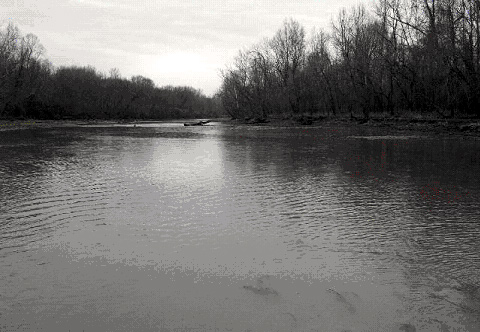
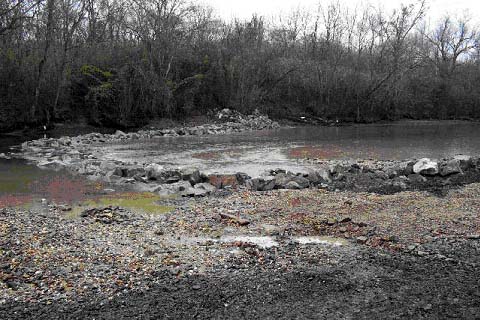
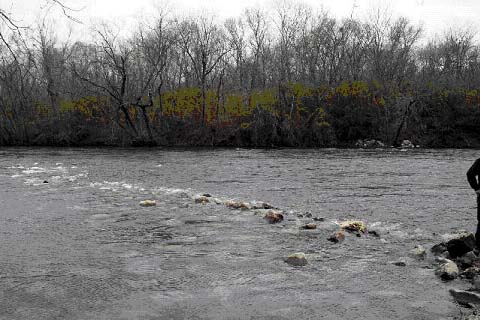
ODWC personnel completed the cross vane in March 2004. The structure is U-shaped
and extends across the stream with the bottom of the U pointing upstream (see
pictures). It was constructed using large rock placed into the river with heavy
equipment. The sides of the structure are attached to the stream bank at an
elevation equal to the water level when two power turbines are being operated to
produce electricity. The sides of the structure extend upstream at a 20 –
30-degree angle until reaching 1/3 of the way across the channel (two thirds
total). The sides the structure slope downwards at a 2 – 7 degree angle from the
bank toward the channel center. The tip of the U, which composes the middle
third of the structure, is slightly below the water level during base-flow
periods.
There are two main purposes of the cross vane structure. First, bank
stabilization is obtained as flow is diverted to the middle of the stream. This
reduces stress to the banks as stream energy is forced to the center of the
channel. Secondly, in-stream habitat is created by this energy as it cuts deeper
pool habitat below the structure. Deepening also results above the structure as
flow is impounded upstream. Both of these areas create resting/ambush sites for
trout, out of the current, behind the rocks.
ODWC biologist plan to continue habitat improvements at the lower Illinois River
over the coming years. Several other projects are possible and, given adequate
funding and resources, this stream should continue to benefit from new
enhancement initiatives. *(Click on pictures to view larger image)