
Thermal Enhancement of the Lower Mountain Fork River Trout Fishery
The Oklahoma
Department of Wildlife Conservation’s (ODWC) Fish Division manages a
year-round trout fishery in a 12-mile reach of the lower Mountain Fork River
below Broken Bow Dam. This fishery provides a high quality angling
opportunity for trout in the scenic Ouachita Mountains of southeast
Oklahoma. However, seasonal atmospheric heating of the stream coupled
with the timing, duration and temperature of hydropower and sluice releases
from the dam limit the potential of the trout population and subsequent
angler success.
The ODWC Fisheries
Division, in cooperation with the US Army Corps of Engineers and Southwestern
Power Administration, used a river temperature and hydrodynamic model to
determine water releases needed to maintain suitable stream temperature (<68
degrees F) in concert with other reservoir and hydropower objectives. The
seasonal availability of cold water in Broken Bow Reservoir (BBR) and the
life-span of this resource during a range of reservoir operations were also
assessed. Results from these projects showed that BBR has enough cold
water to support the year-round fishery. However, there is a mechanical
inability to release the coldest water from the depths of BBR regardless of the
operational strategies used.
BBR thermally stratifies during summer causing a difference in elevation
between the cold water layer and the intake structures. This is most
notable during dry periods when the elevation of BBR is low. In
addition, the behavior of water as it approaches the intakes negatively
influences release temperatures. These issues all complicate
management of the trout stream during warm months because release
temperatures are too warm for trout even though inaccessible cold water
exists.
The temperature management challenges in the lower Mountain Fork River culminated during summer 2005 causing an interruption in operation of the fishery. During this time BBR was very low and the temperature of sluice releases exceeded that tolerated by trout. Stocking of the stream was temporarily postponed until cooler weather solved this problem. Such breaks in the stocking schedule interrupt angling at the stream and have a ripple effect on the local economy which depends on visitation attributed to trout fishing.
 Based
on these insights, it is apparent that improving thermal characteristics of
this fishery over time and a wide range of circumstances is necessary.
This will involve enhanced access to and subsequent release of colder water
from deep in BBR. Technology for selective withdrawal is
available to accomplish this, but the impacts and feasibility of the various
options needs to be assessed. A water quality model
of Broken Bow Reservoir is currently being developed that will help managers
understand how selective withdrawal will affect water quality in the impoundment
and tailwater. If these results are favorable a feasibility study of
tractable improvement options will be conducted. Finally, implementation
of the most feasible alternatives will occur if adequate funding and support
from stakeholders and cooperating agencies exist.
Based
on these insights, it is apparent that improving thermal characteristics of
this fishery over time and a wide range of circumstances is necessary.
This will involve enhanced access to and subsequent release of colder water
from deep in BBR. Technology for selective withdrawal is
available to accomplish this, but the impacts and feasibility of the various
options needs to be assessed. A water quality model
of Broken Bow Reservoir is currently being developed that will help managers
understand how selective withdrawal will affect water quality in the impoundment
and tailwater. If these results are favorable a feasibility study of
tractable improvement options will be conducted. Finally, implementation
of the most feasible alternatives will occur if adequate funding and support
from stakeholders and cooperating agencies exist.
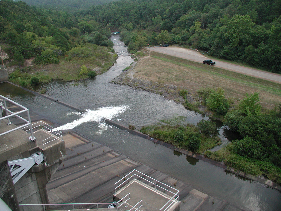
Spillway structure at Broken Bow Reservoir