


Page 67 - 2018 NOV/DEC Outdoor Oklahoma
P. 67
For Clay Barnes and  Jordan  Shope,  a  wildlife  biolo-
          gist and a technician for the Oklahoma Department of
          Wildlife  Conservation,  going  to  the  office  means  driv-                                       WILDLIFEDEPARTMENT.COM
          ing an ATV packed with climbing gear and a telescopic
          camera onto a small pontoon boat, crossing Broken Bow
          Lake, then navigating the twisting trails within McCurtain
          County Wilderness Area’s 14,000-plus acres.
            Together, they manage the Wildlife Department’s origi-
          nal conservation area and a small population of red-cock-
          aded woodpeckers found there.
            Barnes and Shope are tasked with monitoring the rare
          birds, especially during their vulnerable nesting season,
          and maintaining the area’s habitat throughout the year
          so the birds can persist in Oklahoma.
            “Wildlife and habitat go hand-in-hand,” Barnes said.
          “And for Oklahoma’s red-cockaded woodpeckers, habitat
          means shortleaf pines with cavities serving as roost and
          nest trees, and an open understory for foraging.”
            Like other woodpeckers, red-cockaded woodpeckers
          live and raise their young in holes they’ve created in trees.
          But this particular species only builds cavities in living
          pines infected with the naturally occurring red heart fun-
          gus. The fungus softens the wood, making it easier for the
          woodpeckers to hollow out a small cavity. Even with the
          softened wood, construction may take two years.
            “Red-cockaded woodpeckers are social and live in
          small family units in a group or cluster of trees. After a
          roost cavity is drilled, the birds chip bark away from the
          entrance hole. This lets the sticky pine resin found under-
          neath the bark coat each bird’s tree and offers some pro-
          tection from potential predators like snakes.”
            The birds maintain resin flows year-round, which stains
          active woodpecker trees a dull gray.
            Barnes and Shope take note of which trees the woodpeck-
          ers appear to be using as they monitor the birds throughout
          the year. But the significance of gray, or active, trees increas-
          es substantially during the spring nesting season.

          COURTESY JIM JOHNSTON


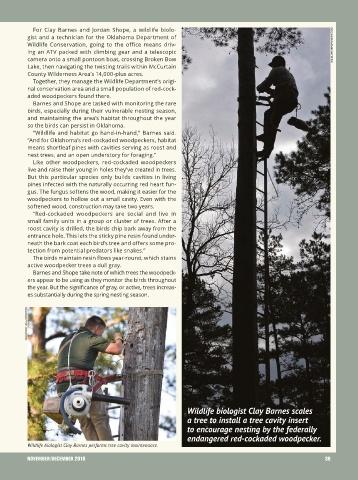
                                                              Wildlife biologist Clay Barnes scales
                                                              a tree to install a tree cavity insert
                                                              to encourage nesting by the federally
                                                              endangered red-cockaded woodpecker.
          Wildlife biologist Clay Barnes performs tree cavity maintenance.

          NOVEMBER/DECEMBER 2018                                                                           39

