


Page 71 - 2018 NOV/DEC Outdoor Oklahoma
P. 71
Safety


          Oklahoma Hunter Education


          Safe Zones of Fire                                Ammunition Safety


             OBJECTIVE 4                                       OBJECTIVE 5


          The area into which a hunter may shoot safely is referred  It is extremely important to know the correct methods
          to as a “zone of fire.” When hunting alone, your safe   for handling ammunition. Following a few rules can
          zone of fire will be determined by your field of view, the  keep you and your hunting partners safe.
          presence of trees, rocks, water or other obstacles and the   •  Carry only the correct size of ammunition for your
          range of your firearm.
                                                                firearm.

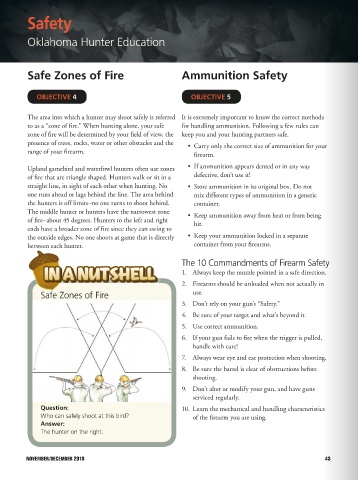
          Upland gamebird and waterfowl hunters often use zones   •  If ammunition appears dented or in any way
          of fire that are triangle shaped. Hunters walk or sit in a   defective, don’t use it!
          straight line, in sight of each other when hunting. No   •  Store ammunition in its original box. Do not
          one runs ahead or lags behind the line. The area behind   mix different types of ammunition in a generic
          the hunters is off limits–no one turns to shoot behind.   container.
          The middle hunter or hunters have the narrowest zone   •  Keep ammunition away from heat or from being
          of fire–about 45 degrees. Hunters to the left and right   hit.
          ends have a broader zone of fire since they can swing to
          the outside edges. No one shoots at game that is directly   •  Keep your ammunition locked in a separate
          between each hunter.                                  container from your firearms.

                                                            The 10 Commandments of Firearm Safety

                                                            1.  Always keep the muzzle pointed in a safe direction.
                                                            2.  Firearms should be unloaded when not actually in
              Safe Zones of Fire                                use.
                                                            3.  Don’t rely on your gun’s “Safety.”

                                                            4.  Be sure of your target and what’s beyond it.
                                                            5.  Use correct ammunition.
                                                            6.  If your gun fails to fire when the trigger is pulled,
                                                                handle with care!
                                                            7.  Always wear eye and ear protection when shooting.
                                                            8.  Be sure the barrel is clear of obstructions before
                                                                shooting.
                                                            9.  Don’t alter or modify your gun, and have guns
                                                                serviced regularly.
              Question:                                     10.  Learn the mechanical and handling characteristics
              Who can safely shoot at this bird?                of the firearm you are using.
              Answer:
              The hunter on the right.


          NOVEMBER/DECEMBER 2018                                                                           43

