Why Does It Matter if Trees Are Growing on a Pond Dam? What’s the Problem Anyway?
The problem is created by the deep and expansive root systems of woody plants, especially those of large trees. Roots grow through the dam, spanning the dimensions from the downstream slope to the upstream slope and can make a pathway for water to seep along the roots into the dam, therefore jeopardizing the integrity of the structure over time. This effect can be seen where trees are growing in and around the spillway of a pond.
In high-rain events as water rushes over the spillway, where trees are growing, there are fewer, or no, herbaceous plants growing that would stabilize the soil and slow down the flow of the water. This increases the likelihood of erosion and, ultimately, dam failure.
When constructing a new pond and dam, you learn that to extend the life of the dam, it needs to be kept free of woody plants through your habitual maintenance. In this case, with the blank slate of a new construction, it is simple enough to mow annually, use woody plant-targeting herbicides as needed, or conduct frequent prescribed fires on the dam to manage the vegetation. However, with an existing pond and dam, perhaps the structure predates your ownership of the land, and now, trees have been allowed to establish on the dam. In this case, what do you do? Cut them or leave them?
The best answer here, frustratingly enough, is “it depends”. But truly, once trees or dense shrub thickets have established, your management approach to correct the issue will vary depending on the severity. At this point, suggestions could be anywhere from “chainsaw a few trees and start mowing” to “doze the dam and start over”. The goal is to reclaim as much real estate of the dam as possible and avoid creating further issues with your treatment efforts.
However, a caveat must be stated – do not panic. Even a pond dam that has been overtaken with trees, if left alone, is not necessarily doomed for an imminent burst, and in fact may last decades without much sign of impending failure.
Scenario 1 - With Minor Early-Successional Woody Encroachment
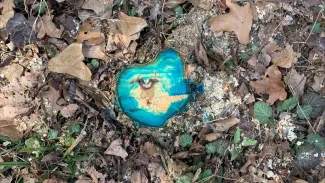
If woody stems, with the majority less than three inches, are beginning to encroach on the dam, mow with tractor and implement, apply a foliar or basal bark herbicide treatment to the target plants, or conduct a prescribed fire on the area. Continue these preemptive practices, as applicable, to maintain the dam free of woody plants.
Scenario 2 - With Mid- to Late-Successional, Diverse Encroachment
Five Inches or Less
Trees that are five inches DBH (diameter at breast height) or less should be removed. Cut the tree as low to the ground as possible. For hardwoods and shrubs, follow the cut by ‘painting’ the stump with an appropriate herbicide like triclopyr to reduce the threat of resprouting. Always adhere to herbicide label instructions for use and safety. For eastern red cedar (ERC), cut below the lowest green limb, as close to the ground as possible. There is no need for a follow-up herbicide stump treatment for ERC.
When using herbicides on dams, especially if you have a high stem density of 5 DBH, attack the problem in waves, treating a percentage of the stems each year. During year one, cut and spray scattered trees while leaving some untreated, standing trees scattered around it. During year two, do another wave with the same approach, treating another percentage of the individuals you had left untreated the previous year. This method will allow more time (and weather events) for the soil to settle around the dying roots, keeping it more stable versus treating every stem in one year.
Six to Eight Inches
Trees six to eight inches DBH can also be cut, but hardwoods this size should not be treated with herbicide. For this size-class and greater, their established root systems are larger and more expansive throughout the soil. Using herbicide will kill that root system, the roots will deteriorate within the dam and could further exacerbate structural degradation.
Greater than Eight Inches
Trees greater than eight inches DBH may best be left alone. The resprouting threat brought on by cutting, and the root rot after applying herbicide to this size-class of tree may be more harmful than it is helpful. However, be aware that allowing these larger size-class trees to remain poses another risk. If an 18-inch tree growing on the dam is blown over, you will be left with a crater where the root ball was. And a 10-inch tree, if its roots are not already allowing even minimal seep, that basic problem will likely arise at some point.
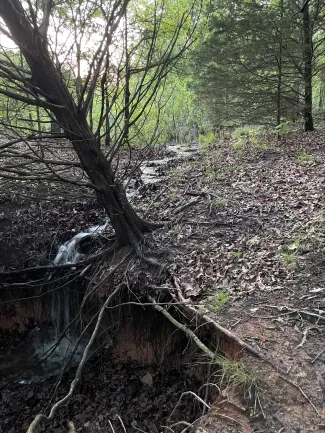
If you notice that your dam is experiencing leaks or if you have an eroded spillway, these issues can be dealt with by clearing the culprit-sections and patching them with more material. At this point, heavy equipment and dirt need to be brought in, but saving the pond is worth the effort. Of course, the best cure is prevention, so take the steps to reclaim and maintain your dam before it requires full rehabilitation.
If you are concerned about the state of your pond dam, contact your ODWC private lands biologist or other land and pond professionals so they can help you evaluate the situation and make suggestions for management.