When you hear the word “quail,” you likely picture the familiar northern bobwhite and its distinctive whistle. But Oklahoma is actually home to two species of quail: the widespread northern bobwhite, and the scaled quail. While bobwhites can be found statewide, scaled quail occupy a much smaller range, primarily in the panhandle and occasionally along the far western edge of the state.
Scaled quail are also known by a handful of other names: blue quail, cottontop, or simply “scalies” or “blues.” Their scientific name, Callipepla squamata, hints at one of their most striking features: the scalloped, scale-like pattern of the feathers across their breast, back, and neck. Their overall bluish-gray plumage is accented with buff tones, and both sexes sport a short white “cotton-top” crest. Females often have light striping along the chin, but otherwise males and females look remarkably similar.
Habitat preferences set scaled quail apart from their bobwhite cousins. They thrive in open, arid landscapes such as sand sagebrush grasslands, shortgrass high plains, pinyon-juniper, and cholla cactus country. These habitats echo the desert southwest, which makes Oklahoma’s panhandle feel a little more like New Mexico or Texas than the rest of the state.
Their voices are just as distinctive as their appearance. Instead of the bobwhite’s clear whistle, scaled quail call with a two-syllable “pe-cos” that echoes across the prairie.
In summer they feed heavily on insects like beetles and grasshoppers, while in fall and winter their diets shift to the seeds of native grasses and forbs. Although they can meet most of their water needs through food, they will use available water sources when present.
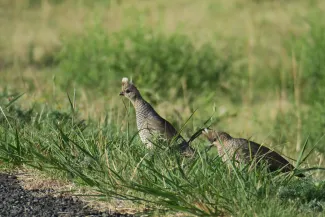
Scaled quail live much of the year in groups called coveys, which can be impressively large - 20 to more than 50 birds. At night they roost on the ground in a circle, tails together and heads facing outward, a behavior that helps them detect and evade predators. In the breeding season, females nest on the ground and may raise one or even two broods of chicks if conditions are favorable.
For hunters, photographers, and birdwatchers alike, pursuing scaled quail presents a unique challenge. Coveys often post a sentinel bird on lookout, and when disturbed, they are far more likely to sprint than to flush. In fact, scaled quail are among the fastest quail on foot, capable of reaching speeds near 15 miles per hour. Their wary nature, coupled with the rugged landscapes they inhabit, makes encounters both memorable and rewarding.
Though they are less abundant than bobwhites, scaled quail remain an important part of Oklahoma’s strong quail heritage. Their presence reminds us that the state bridges two worlds - wooded prairies of the east and wide-open deserts of the west. Protecting the unique habitats of the panhandle ensures that future generations will still have the chance to hear a covey of “blues” erupt from the sage, or watch a line of scalies racing through the shortgrass prairie.
Next time you find yourself in the panhandle, keep an eye out – you might just catch a glimpse of a cotton-top on an old wooden fence post, a testament to Oklahoma’s wild frontier. It’s an encounter that will show you just why Oklahoma’s “other” quail species is worth knowing.