
The first day of September is a time-honored moment for many hunters across Oklahoma, as it marks the beginning of dove season and the official kickoff to the state’s many upcoming fall seasons.
Generations of family and friends have long enjoyed dove hunts. No expensive gear is needed, and with the right setup, you can even carry on a leisurely conversation without the fear of alerting your quarry. Better still, it’s the perfect time to take the younger family members along to introduce them to hunting.
But did you know there are three species of dove that hunters can pursue in the Sooner State? The most common is the mourning dove, but if you’re in the right place at the right time, you’re likely to see two other common species – the white-winged dove and the Eurasian collared dove.
Mourning Dove
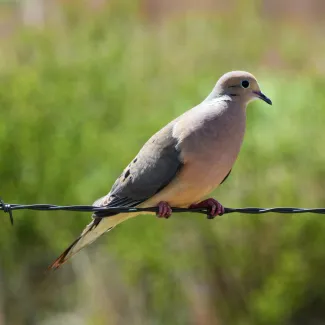
As mentioned before, the mourning dove is the most common and most abundant. This slender gray bird – and the smallest of the three – gets its name from the male’s long, lilting and mournful call – an almost “crying” sound. Found throughout the state, the mourning dove frequents agricultural areas in its search for seeds and grains, while taking advantage of highline wires and fencerows to rest, and scattered bare trees for roosting. Mourning doves are very tolerant of hot, dry areas, but water is still a precious commodity, and they can easily be found at any water source late in the day (ponds, puddles after a rain, or livestock tanks). Another trait of their adaptability is their choice of nesting sites – anywhere from trees, when available, to clusters of vegetation on the ground, and even gutters on houses or backyard birdhouses. Mourning doves are also opportunistic enough to choose previously used nests… even those once occupied by squirrels.
Throngs of these popular game birds can be found along stretches of graveled county roads – especially those lined with sunflowers – as well as on the highline wires above.
Seasoned dove hunters know the rush of excitement that comes with the sound of the mourning dove’s wings “whistling” as the bird takes flight.
Despite being a migratory bird, mourning doves have a year-round presence in Oklahoma. Birds seen in the winter are very often those that have migrated here from northern states, while those seen here in the warmer months have migrated south into Texas and Mexico.
Adult mourning doves are about 12 inches in length, from beak to tip of tail, and weigh about four to five ounces.
White-winged Dove
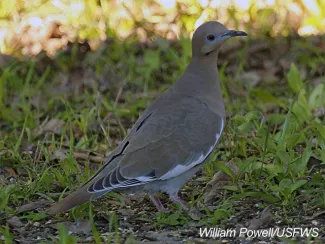
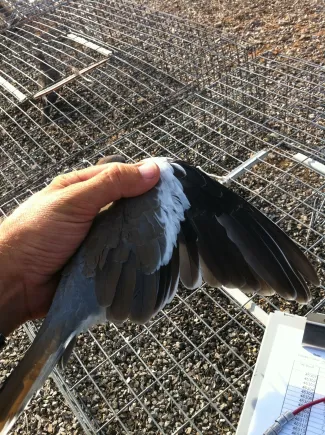
The white-winged dove, as its name implies, has a bold white leading edge on each wing. Only slightly heavier than the mourning dove, this bird’s call is likened to the phrase “who cooks for you?”
More historically a bird of the barren landscapes of Texas and Mexico, the range of the white-winged dove has slowly expanded northward and eastward and they can readily be found in parts of Oklahoma, Kansas and Arkansas.
Some groups of white-winged doves remain migratory, while others tend to set up permanent residence in areas where conditions have year-round suitability. They are found everywhere from scrubby open areas to deserts and even urban areas. Just as it is with mourning doves, agricultural areas are hot spots for the white-winged dove, but they also key in on bird baths and bird feeders in many suburban backyards.
Nesting sites in Oklahoma often include mesquite trees.
Eurasian Collared Dove
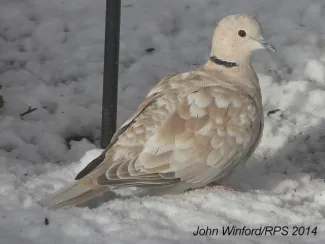
Although not a native species to Oklahoma (or North America), the largest of Oklahoma’s three common doves is the Eurasian collared dove. Adult collared doves can reach 13 inches in length and weigh more than eight ounces. As their name suggests, the back of their neck is ringed with a very distinct black collar, while the rest of their plumage is overall light to dark gray. The collar is actually absent in young birds, developing as the bird matures from juvenile to adult.
The Eurasian collared dove’s name also suggests its origins – throughout Europe and Asia, and even parts of North Africa. It found its way into the United States via some escapees in the Bahamas about five decades ago, and is now found in almost all of the lower 48 states and Mexico. Although not considered migratory like its cousins, the Eurasian collared dove is dispersive – meaning its range expands over time as birds leave the nests and seek their own places to call home.
The calls of the Eurasian collared dove are easily identified, with the typical call being an ongoing three-note “who-WHO-who.” In flight, and most often just before landing, they will emit a few longer, raspy notes that – in my opinion – sound like they are forcing a laugh after a bad joke.
Eurasian collared doves are probably the most tolerant of humans and will readily build nests on or around manmade structures, even in urban areas. They are frequent visitors to any backyard bird feeder or bird bath.
For those planning to hunt doves in Oklahoma, be sure to consult the hunting regulations for information on license requirements, daily bag limits and possession limits, as well as other general regulations pertaining to the pursuit of migratory game birds.