HUNTERS WINNING THE GAME IN A BIG WAY
"TAKE A DOE" TAKES OFF IN STATE'S 2ND-BEST SEASON EVER
The 2024-25 big game hunting season in Oklahoma showcased another year of remarkable success for hunters across the state. Again, favorable environmental and habitat conditions played crucial roles, creating optimal circumstances for wildlife and the people pursuing them.
Coupled with robust and healthy wildlife populations, those factors contributed to a substantial combined deer harvest of 128,375 — a figure that underscores the continued vitality of Oklahoma’s big game resources.
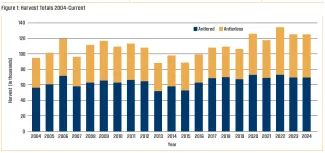
That number ranks this past deer season as No. 2 most-successful in terms of number of animals harvested. The highest harvest for an Oklahoma deer season was 134,158 combined in all 2022-23 deer seasons.
Equally noteworthy was the continued active participation and conscientious effort put forth by deer hunters to support responsible wildlife management practices.
A particularly significant highlight in 2024- 25 was the high percentage of antlerless deer harvested, which made up 48% of the total take. This marks a new record for the proportion of antlerless deer in the overall harvest, indicating a widespread understanding among hunters of the importance of managing herd dynamics to prevent overpopulation and ensure ecological balance. And it’s likely that the Oklahoma Department of Wildlife Conservation’s “Hunters in the Know … Take a Doe!” public awareness campaign helped generate those results.
Of the state’s 77 counties, 70 of them reported at least 40% antlerless deer harvest. The goal is a harvest of between 40% and 45% antlerless deer.
The seven counties that fell short of 40% antlerless harvest were primarily in the far northwest part of the state, where deer densities are lower and hunting season structures limit antlerless harvest.
In short, more hunters made more good deer herd management decisions this past season. This deliberate focus on harvesting antlerless deer is more than just a statistic — it reflects a strategic approach aimed at preserving the long-term health and sustainability of Oklahoma’s deer population. By reducing pressure on food sources and helping to maintain stable buck-to-doe ratios, such practices are essential to sustaining thriving wildlife populations for future generations of hunters and outdoor enthusiasts alike.
For a look at total deer harvest from 2004 to the present, see Figure 1.
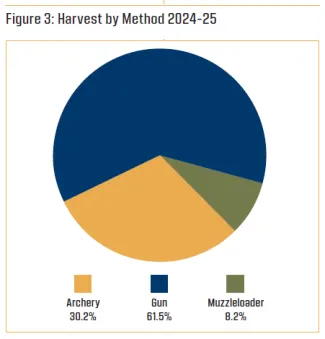
Oklahoma’s various firearms hunting seasons played a dominant role in the overall success of the 2024-25 deer harvest. Together, the state’s firearm seasons — which include the 16-day modern gun season, the youth gun season designed to engage and educate young hunters, and the holiday antlerless season focused on strategic population control — contributed a combined harvest total of 79,008 deer. These seasons continue to be the most productive periods for deer hunting in the state, thanks to their accessibility and broad participation among hunters of all experience levels.
Table 1: Harvest by County, Sex, and Method
Archery | Gun | Muzzleloader | |||||
|---|---|---|---|---|---|---|---|
| County | Antlerless | Antlered | Antlerless | Antlered | Antlerless | Antlered | Total |
| Adair | 170 | 160 | 399 | 303 | 53 | 166 | 1,251 |
| Alfalfa | 131 | 177 | 428 | 407 | 35 | 39 | 1,217 |
| Atoka | 377 | 361 | 668 | 722 | 82 | 179 | 2,389 |
| Beaver | 13 | 33 | 95 | 251 | 8 | 21 | 421 |
| Beckham | 149 | 169 | 644 | 667 | 52 | 55 | 1,736 |
| Blaine | 62 | 109 | 305 | 456 | 21 | 19 | 972 |
| Bryan | 256 | 262 | 521 | 473 | 30 | 53 | 1,595 |
| Caddo | 225 | 344 | 698 | 965 | 53 | 73 | 2,358 |
| Canadian | 130 | 202 | 377 | 369 | 34 | 28 | 1,140 |
| Carter | 202 | 268 | 462 | 604 | 28 | 44 | 1,608 |
| Cherokee | 386 | 371 | 647 | 541 | 86 | 194 | 2,225 |
| Choctaw | 282 | 272 | 402 | 450 | 58 | 93 | 1,557 |
| Cimarron | 8 | 11 | 8 | 79 | 15 | 121 | |
| Cleveland | 295 | 316 | 397 | 328 | 46 | 72 | 1,454 |
| Coal | 227 | 271 | 416 | 453 | 30 | 77 | 1,474 |
| Comanche | 128 | 158 | 242 | 290 | 33 | 37 | 888 |
| Cotton | 74 | 103 | 190 | 211 | 20 | 22 | 620 |
| Craig | 238 | 264 | 477 | 556 | 40 | 70 | 1,645 |
| Creek | 354 | 423 | 795 | 705 | 65 | 116 | 2,458 |
| Custer | 63 | 106 | 335 | 447 | 11 | 22 | 984 |
| Delaware | 355 | 399 | 562 | 476 | 81 | 149 | 2,022 |
| Dewey | 76 | 114 | 408 | 585 | 37 | 28 | 1,248 |
| Ellis | 52 | 103 | 293 | 467 | 15 | 36 | 966 |
| Garfield | 91 | 161 | 420 | 482 | 29 | 40 | 1,223 |
| Garvin | 226 | 295 | 544 | 646 | 42 | 70 | 1,823 |
| Grady | 258 | 337 | 716 | 764 | 71 | 69 | 2,215 |
| Grant | 190 | 248 | 792 | 660 | 59 | 62 | 2,011 |
| Greer | 56 | 82 | 246 | 279 | 16 | 30 | 709 |
| Harmon | 53 | 68 | 194 | 183 | 11 | 21 | 530 |
| Harper | 14 | 56 | 124 | 264 | 1 | 28 | 487 |
| Haskell | 168 | 157 | 389 | 325 | 47 | 109 | 1,195 |
| Hughes | 222 | 260 | 441 | 596 | 37 | 106 | 1,662 |
| Jackson | 133 | 155 | 260 | 320 | 19 | 31 | 918 |
| Jefferson | 158 | 221 | 329 | 314 | 22 | 53 | 1,097 |
| Johnston | 144 | 204 | 347 | 413 | 14 | 51 | 1,173 |
| Kay | 140 | 180 | 499 | 538 | 35 | 43 | 1,435 |
| Kingfisher | 119 | 173 | 464 | 412 | 16 | 39 | 1,223 |
| Kiowa | 91 | 118 | 238 | 318 | 14 | 32 | 811 |
| Latimer | 132 | 149 | 164 | 207 | 26 | 112 | 790 |
| Le Flore | 298 | 296 | 561 | 471 | 99 | 189 | 1,914 |
| Lincoln | 346 | 352 | 1,011 | 879 | 69 | 87 | 2,744 |
| Logan | 390 | 448 | 762 | 636 | 48 | 82 | 2,366 |
| Love | 130 | 147 | 192 | 254 | 9 | 13 | 745 |
| Major | 83 | 155 | 384 | 513 | 23 | 40 | 1,198 |
| Marshall | 82 | 87 | 104 | 144 | 5 | 9 | 431 |
| Mayes | 299 | 305 | 559 | 482 | 62 | 114 | 1,821 |
| McClain | 192 | 221 | 344 | 380 | 25 | 34 | 1,196 |
| McCurtain | 554 | 408 | 930 | 723 | 136 | 259 | 3,010 |
| McIntosh | 167 | 155 | 283 | 308 | 29 | 67 | 1,009 |
| Murray | 75 | 141 | 175 | 274 | 15 | 19 | 699 |
| Muskogee | 214 | 235 | 376 | 413 | 29 | 69 | 1,336 |
| Noble | 136 | 181 | 561 | 576 | 47 | 53 | 1,554 |
| Nowata | 198 | 189 | 518 | 596 | 34 | 54 | 1,589 |
| Okfuskee | 137 | 185 | 336 | 398 | 34 | 51 | 1,141 |
| Oklahoma | 424 | 521 | 423 | 396 | 26 | 33 | 1,823 |
| Okmulgee | 176 | 225 | 395 | 407 | 33 | 80 | 1,316 |
| Osage | 567 | 687 | 1,535 | 1,687 | 111 | 152 | 4,739 |
| Ottawa | 208 | 270 | 447 | 423 | 44 | 91 | 1,483 |
| Pawnee | 261 | 248 | 817 | 625 | 55 | 84 | 2,090 |
| Payne | 324 | 383 | 888 | 752 | 47 | 60 | 2,454 |
| Pittsburg | 463 | 493 | 714 | 737 | 96 | 279 | 2,782 |
| Pontotoc | 299 | 392 | 637 | 664 | 59 | 117 | 2,168 |
| Pottawatomie | 393 | 438 | 722 | 767 | 78 | 120 | 2,518 |
| Pushmataha | 469 | 419 | 656 | 594 | 101 | 212 | 2,451 |
| Roger Mills | 70 | 143 | 538 | 630 | 32 | 49 | 1,462 |
| Rogers | 580 | 565 | 800 | 724 | 76 | 97 | 2,842 |
| Seminole | 216 | 259 | 527 | 526 | 44 | 97 | 1,669 |
| Sequoyah | 239 | 264 | 563 | 482 | 70 | 191 | 1,809 |
| Stephens | 213 | 332 | 485 | 538 | 22 | 55 | 1,645 |
| Texas | 5 | 12 | 10 | 96 | 6 | 129 | |
| Tillman | 123 | 168 | 249 | 290 | 25 | 15 | 870 |
| Tulsa | 281 | 304 | 306 | 270 | 20 | 32 | 1,213 |
| Wagoner | 333 | 327 | 540 | 433 | 48 | 75 | 1,756 |
| Washington | 209 | 220 | 460 | 520 | 31 | 39 | 1,479 |
| Washita | 44 | 65 | 260 | 302 | 14 | 19 | 704 |
| Woods | 79 | 149 | 346 | 517 | 22 | 48 | 1,161 |
| Woodward | 101 | 159 | 334 | 559 | 17 | 39 | 1,209 |
| County Total | 15,826 | 18,408 | 35,684 | 37,512 | 3,112 | 5,634 | 116,176 |
| OLAP Total | 433 | 387 | 0 | 0 | 0 | 0 | 820 |
| WMA Total | 1,873 | 1,676 | 2,010 | 1,762 | 807 | 660 | 8,788 |
| Tribal Total | 333 | 333 | 846 | 815 | 91 | 173 | 2,591 |
| Grand Total | 18,465 | 20,804 | 38,540 | 40,089 | 4,010 | 6,467 | 128,375 |
The muzzleloader season, which spans nine days and appeals to those who prefer muzzle-loading firearms, also proved fruitful. Hunters using this method harvested 10,580 deer. Meanwhile, archery season, which offers the longest hunting window and a more solitary, challenging experience, yielded a significant total of 38,787 deer. This reflects both the growing number of bowhunters in the state and the effectiveness of archery as a method of harvest when practiced with skill and patience.
Together, these seasonal breakdowns high- light the diverse range of hunting opportunities available in Oklahoma and emphasize the contributions of all methods in achieving a balanced, sustainable harvest across the state.
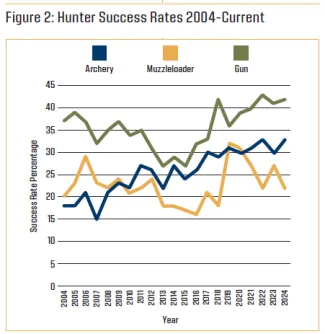
Figure 2 presents success rates by hunting method. Figure 3 illustrates each method’s proportional contribution to the total harvest.
Oklahoma distinguishes itself among landlocked states with an impressive range of ecological diversity that few others can match. Spanning from the lush, swampy pine forests of the south-eastern corner to the windswept, sagebrush-dotted shortgrass prairies of the northwest, the state’s varied landscapes create a mosaic of habitats that support a wide array of wildlife. For deer hunters, this means an equally diverse set of hunting experiences — from stalking white-tailed deer through dense bottomlands to glassing open plains for deer movement at long range.
This rich variety in terrain directly influences deer distribution and hunting opportunities across the state. Habitat type, food availability, climate, and land use all contribute to variations in local deer populations, which in turn affect harvest rates from one county to the next.
Furthermore , access to public hunting lands, including but not limited to Oklahoma’s wildlife management areas (WMAs), also plays a significant role in shaping hunting success. To provide a clearer picture of how deer harvests differ by region, Table 1 presents county-level harvest totals, specifically excluding deer taken on public lands such as WMAs. This focus on private-land harvest data offers a more localized perspective on deer abundance and hunting pressure.
The top-three counties by total deer harvest during the 2024-25 season were:
- Osage County, leading with a total of 4,739 deer harvested, continuing its long-standing reputation as one of the state’s premier deer hunting areas.
- McCurtain County, yielding 3,010 deer, a testament to the productivity of southeastern Oklahoma’s forested habitats.
- Rogers County, with 2,842 deer, which reflects both a strong local deer population and active hunter participation.
PUBLIC LAND CONTRIBUTION TO DEER HARVEST
Although lands managed by the ODWC — including WMAs and other public properties — make up only about 3% of Oklahoma’s total land area, their contribution to the state’s overall deer harvest is significantly greater than their size might suggest. These public lands serve as vital access points for hunters who may not have private land available,
and they are managed with a focus on habitat quality, wildlife conservation, and hunter opportunity.
Despite their relatively limited footprint, WMAs and other ODWC-managed properties accounted for an impressive 6.9% of the total statewide deer harvest during the 2024–25 season. This disproportionately high contribution highlights the effectiveness of public land management strategies and the value these areas provide to Oklahoma’s hunting community.
Many of these lands feature diverse habitats, active wildlife management practices such as prescribed burns or food plot development, and regulated hunting pressure, all of which contribute to their productivity. In addition, the accessibility of these areas helps ensure that hunting remains an inclusive and equitable outdoor pursuit, regardless of land ownership.
Comprehensive data on deer harvests from public lands are presented in Table 2, offering a closer look at the performance of individual WMAs and illustrating the important role these public resources play in the state’s broader wildlife management goals.
Table 2: WMA Harvest by Sex and Method
Archery | Gun | Muzzleloader | |||||
|---|---|---|---|---|---|---|---|
| WMA Name | Antlerless | Antlered | Antlerless | Antlered | Antlerless | Antlered | Total |
| Arcadia Lake WMA | 32 | 12 | 2 | 0 | 0 | 2 | 48 |
| Altus-Lugert WMA | 24 | 25 | 0 | 5 | 14 | 9 | 77 |
| Arbuckle Springs WMA | 14 | 20 | 4 | 8 | 0 | 0 | 46 |
| Arkansas River Coe | 1 | 3 | 4 | 2 | 0 | 1 | 11 |
| Atoka PHA | 2 | 5 | 10 | 12 | 6 | 4 | 39 |
| Atoka WMA | 18 | 17 | 13 | 4 | 0 | 3 | 55 |
| Bamberger WMA | 0 | 1 | 1 | 2 | 0 | 0 | 4 |
| Barren Fork WMA | 0 | 0 | 4 | 4 | 0 | 0 | 8 |
| Beaver River (McFarland Unit) | 1 | 1 | 1 | 8 | 0 | 1 | 12 |
| Beaver River WMA | 4 | 6 | 1 | 11 | 4 | 2 | 28 |
| Beavers Bend Sp (Golf Course) | 1 | 2 | 1 | 2 | 0 | 0 | 6 |
| Black Kettle WMA | 21 | 25 | 153 | 143 | 38 | 11 | 391 |
| Blue River Public Hunting & Fishing Area | 19 | 17 | 6 | 7 | 0 | 0 | 49 |
| Broken Bow WMA | 5 | 3 | 4 | 6 | 2 | 3 | 23 |
| Burtschi PFA | 4 | 4 | 1 | 1 | 0 | 2 | 12 |
| Candy Creek WMA | 14 | 10 | 0 | 2 | 0 | 1 | 27 |
| Canton WMA | 48 | 25 | 9 | 42 | 25 | 4 | 153 |
| Canton WRP | 0 | 0 | 1 | 1 | 0 | 0 | 2 |
| Cherokee WMA (GMA Portion) | 27 | 34 | 11 | 17 | 1 | 0 | 90 |
| Cherokee WMA (PHA Portion) | 16 | 23 | 4 | 30 | 21 | 29 | 123 |
| Chickasaw National Recreation Area | 38 | 21 | 23 | 22 | 7 | 8 | 119 |
| Cimarron Bluff WMA | 1 | 2 | 0 | 0 | 0 | 1 | 4 |
| Cimarron Hills WMA | 2 | 2 | 1 | 0 | 0 | 0 | 5 |
| Cookson WMA | 31 | 29 | 5 | 8 | 1 | 0 | 74 |
| Cooper WMA | 4 | 0 | 0 | 40 | 1 | 2 | 47 |
| Copan Coe Parks | 5 | 4 | 5 | 3 | 1 | 0 | 18 |
| Copan WMA | 20 | 30 | 32 | 44 | 8 | 5 | 139 |
| Cross Timbers WMA | 40 | 63 | 14 | 4 | 0 | 0 | 121 |
| Deep Fork NWR | 11 | 21 | 2 | 2 | 19 | 8 | 63 |
| Deep Fork WMA | 7 | 11 | 26 | 24 | 11 | 13 | 92 |
| Dewey County WMA | 3 | 2 | 1 | 0 | 1 | 1 | 8 |
| Drummond Flats WMA | 7 | 6 | 0 | 0 | 0 | 0 | 13 |
| Ellis County WMA | 7 | 5 | 7 | 25 | 6 | 3 | 53 |
| Eufaula WMA | 40 | 51 | 48 | 41 | 18 | 17 | 215 |
| Fobb Bottoms WMA | 7 | 3 | 13 | 13 | 3 | 0 | 39 |
| Fort Cobb State Park | 0 | 1 | 2 | 2 | 3 | 0 | 8 |
| Fort Cobb WMA | 23 | 20 | 9 | 7 | 13 | 7 | 79 |
| Fort Gibson Coe | 27 | 22 | 6 | 7 | 6 | 2 | 70 |
| Fort Gibson Waterfowl Refuge | 0 | 0 | 0 | 0 | 19 | 13 | 32 |
| Fort Gibson WMA | 161 | 92 | 27 | 88 | 50 | 36 | 454 |
| Fort Sill | 59 | 46 | 59 | 44 | 42 | 19 | 269 |
| Fort Supply WMA | 23 | 17 | 7 | 23 | 10 | 1 | 81 |
| Four Canyon Preserve | 0 | 0 | 0 | 0 | 1 | 0 | 1 |
| Ft. Gibson WRP | 0 | 0 | 2 | 0 | 0 | 0 | 2 |
| Gary Sherrer WMA (Bolen Hollow) | 0 | 0 | 2 | 0 | 0 | 0 | 2 |
| Gist WMA | 1 | 0 | 0 | 0 | 0 | 0 | 1 |
| Grady Co. WMA | 1 | 1 | 0 | 5 | 0 | 0 | 7 |
| Grassy Slough WMA | 0 | 1 | 0 | 0 | 0 | 0 | 1 |
| Great Salt Plains State Park | 7 | 3 | 2 | 1 | 0 | 0 | 13 |
| Gruber (CGTC) | 17 | 14 | 13 | 59 | 52 | 47 | 202 |
| Hackberry Flat WMA | 1 | 6 | 0 | 1 | 2 | 9 | 19 |
| Heyburn Coe | 0 | 1 | 5 | 1 | 3 | 1 | 11 |
| Heyburn WMA | 10 | 17 | 24 | 15 | 3 | 7 | 76 |
| Hickory Creek WMA | 5 | 6 | 10 | 10 | 2 | 3 | 36 |
| Honobia WMA | 15 | 18 | 47 | 31 | 12 | 30 | 153 |
| Hugo Lake Coe | 22 | 10 | 23 | 8 | 3 | 1 | 67 |
| Hugo WMA | 35 | 31 | 54 | 38 | 16 | 17 | 191 |
| Hulah WMA | 28 | 31 | 79 | 103 | 24 | 14 | 279 |
| James Collins WMA | 28 | 39 | 6 | 11 | 0 | 0 | 84 |
| Jap Beaver PFA | 1 | 0 | 0 | 0 | 0 | 0 | 1 |
| John Dahl WMA (Osage) | 0 | 0 | 6 | 5 | 1 | 2 | 14 |
| Kaw Lake Coe | 22 | 26 | 29 | 22 | 7 | 9 | 115 |
| Kaw WMA | 45 | 45 | 169 | 93 | 45 | 33 | 430 |
| Keystone Coe | 35 | 19 | 21 | 7 | 1 | 1 | 84 |
| Keystone WMA | 64 | 41 | 70 | 27 | 19 | 14 | 235 |
| Lake Thunderbird State Park | 59 | 43 | 0 | 0 | 0 | 0 | 102 |
| Lexington WMA | 32 | 32 | 43 | 4 | 22 | 36 | 169 |
| Little River NWR | 9 | 6 | 25 | 9 | 0 | 0 | 49 |
| Love Valley WMA | 3 | 2 | 37 | 27 | 4 | 3 | 76 |
| Lower Illinois River WMA | 1 | 0 | 5 | 0 | 0 | 0 | 6 |
| Major County WMA | 0 | 1 | 0 | 0 | 0 | 0 | 1 |
| McAlester Army Ammunition Plant | 73 | 72 | 7 | 0 | 0 | 0 | 152 |
| McClellan-Kerr WMA | 19 | 17 | 27 | 20 | 4 | 12 | 99 |
| McCurtain Co. WA | 6 | 4 | 12 | 21 | 0 | 3 | 46 |
| McGee Creek WMA | 8 | 22 | 0 | 4 | 0 | 0 | 34 |
| Mountain Park WMA | 14 | 5 | 0 | 0 | 12 | 5 | 36 |
| Neosho WMA | 11 | 10 | 0 | 2 | 0 | 2 | 25 |
| Okmulgee WMA (GMA Portion) | 4 | 5 | 9 | 10 | 1 | 0 | 29 |
| Okmulgee WMA (PHA Portion) | 6 | 4 | 3 | 2 | 2 | 5 | 22 |
| Oologah Lake Coe | 30 | 18 | 46 | 25 | 9 | 5 | 133 |
| Oologah WMA | 61 | 41 | 101 | 60 | 25 | 8 | 296 |
| Optima National Wildlife Refuge | 0 | 0 | 0 | 3 | 0 | 0 | 3 |
| Optima WMA | 5 | 5 | 3 | 10 | 0 | 1 | 24 |
| Osage WMA - Rock Creek | 1 | 4 | 2 | 11 | 5 | 3 | 26 |
| Osage WMA - Western Wall | 21 | 26 | 2 | 0 | 0 | 0 | 49 |
| Ouachita WMA (Cucumber Creek) | 1 | 2 | 1 | 1 | 1 | 1 | 7 |
| Ouachita WMA (McCurtain Unit) | 11 | 14 | 32 | 20 | 12 | 27 | 116 |
| Ouachita WMA LeFlore | 13 | 7 | 38 | 40 | 16 | 20 | 134 |
| Ozark Plateau NWR | 0 | 2 | 1 | 0 | 0 | 0 | 3 |
| Ozark Plateau WMA | 1 | 0 | 1 | 2 | 1 | 0 | 5 |
| Packsaddle WMA | 2 | 7 | 10 | 63 | 6 | 4 | 92 |
| Pine Creek Coe | 0 | 0 | 4 | 1 | 1 | 0 | 6 |
| Pine Creek WMA | 8 | 3 | 15 | 14 | 5 | 4 | 49 |
| Pontotoc Ridge Preserve | 0 | 0 | 19 | 0 | 0 | 0 | 19 |
| Pushmataha WMA | 23 | 44 | 16 | 13 | 1 | 8 | 105 |
| Red Slough WMA | 31 | 30 | 1 | 0 | 0 | 0 | 62 |
| Rita Blanca WMA | 0 | 0 | 0 | 1 | 1 | 0 | 2 |
| Salt Plains National Wildlife Refuge | 1 | 3 | 55 | 21 | 21 | 4 | 105 |
| Salt Plains NWR Wilderness Area | 0 | 1 | 10 | 4 | 4 | 1 | 20 |
| Sandhills WMA | 3 | 9 | 0 | 0 | 0 | 2 | 14 |
| Sandy Sanders WMA | 2 | 15 | 1 | 5 | 9 | 4 | 36 |
| Sans Bois WMA | 4 | 5 | 7 | 3 | 1 | 5 | 25 |
| Schultz WMA | 1 | 0 | 0 | 1 | 0 | 0 | 2 |
| Sequoyah NWR | 8 | 11 | 0 | 0 | 31 | 5 | 55 |
| Sequoyah NWR (Refuge Island) | 1 | 4 | 0 | 0 | 4 | 0 | 9 |
| Sequoyah Resort Park | 8 | 2 | 0 | 0 | 14 | 7 | 31 |
| Skiatook Coe | 5 | 4 | 5 | 5 | 1 | 1 | 21 |
| Skiatook WMA | 7 | 3 | 33 | 19 | 1 | 2 | 65 |
| Sparrow Hawk WMA | 2 | 1 | 2 | 1 | 0 | 0 | 6 |
| Spavinaw WMA (GMA Portion) | 27 | 17 | 12 | 18 | 2 | 3 | 79 |
| Spavinaw WMA (PHA Portion) | 0 | 2 | 9 | 7 | 2 | 9 | 29 |
| Stringtown WMA | 0 | 2 | 3 | 2 | 1 | 4 | 12 |
| Tenkiller Coe | 12 | 7 | 18 | 7 | 1 | 5 | 50 |
| Tenkiller-B-Cabin WMA | 1 | 3 | 3 | 1 | 1 | 2 | 11 |
| Texoma Coe | 38 | 37 | 42 | 24 | 5 | 8 | 154 |
| Texoma Coe (Burns Run) | 10 | 5 | 1 | 3 | 0 | 0 | 19 |
| Texoma Coe (Lakeside) | 17 | 8 | 5 | 2 | 0 | 0 | 32 |
| Texoma/Washita Arm WMA | 8 | 7 | 10 | 12 | 0 | 0 | 37 |
| Three Rivers WMA | 35 | 20 | 111 | 60 | 31 | 39 | 296 |
| Tishomingo National Wildlife Refuge | 0 | 7 | 31 | 16 | 0 | 0 | 54 |
| Tishomingo WMA | 4 | 4 | 7 | 9 | 1 | 0 | 25 |
| USDA Grazinglands RL | 2 | 0 | 24 | 6 | 0 | 0 | 32 |
| Vanderwork PFA | 0 | 2 | 0 | 2 | 2 | 2 | 8 |
| Verdigris River Coe | 19 | 9 | 1 | 0 | 1 | 0 | 30 |
| Washita NWR | 0 | 0 | 11 | 2 | 0 | 0 | 13 |
| Waurika Lake Coe | 8 | 8 | 4 | 0 | 0 | 0 | 20 |
| Waurika WMA | 65 | 45 | 5 | 0 | 4 | 3 | 122 |
| Webbers Fall WMA | 1 | 0 | 0 | 0 | 0 | 0 | 1 |
| Wichita Mts NWR | 3 | 4 | 1 | 1 | 1 | 0 | 10 |
| Wister WMA | 21 | 12 | 55 | 25 | 20 | 10 | 143 |
| Wister WRP | 0 | 1 | 0 | 0 | 0 | 0 | 1 |
| Yourman WMA | 3 | 2 | 5 | 2 | 0 | 1 | 13 |
| Grand Total | 1,873 | 1,676 | 2,010 | 1,762 | 807 | 660 | 8,788 |
ARCHERY SEASON OVERVIEW
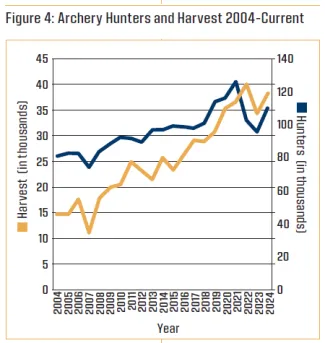
Archery hunters again demonstrated strong performance during the 2024-25 deer season, harvesting 38,787 deer. Although this number did not surpass recent record-setting years, it remains a significant contribution to the overall harvest and continues to reflect the growing presence and impact of bowhunters in Oklahoma’s hunting community.
Importantly, archery hunters maintained a meaningful role in population management efforts. Antlerless deer made up 47% of the total archery harvest, underscoring a continued commitment to balanced herd dynamics. This emphasis on harvesting does is a key aspect of sustainable deer management, helping to regulate population growth and maintain healthy habitat conditions across the state.
Participation in archery season remained strong, with an estimated 109,830 hunters taking part — the highest number recorded since 2021, according to data from ODWC’s annual Game Harvest Survey (GHS). The GHS is a scientifically designed, longstanding monitoring effort to track hunter activity and harvest outcomes across all seasons and methods.
The archery season, offering the longest continuous window for deer hunting, ran uninterrupted from Oct. 1 through Jan. 15, giving hunters over three months of opportunity. The season’s bag limit allowed for the harvest of up to six deer, with no more than two antlered deer, providing flexibility while still aligning with overall management goals.
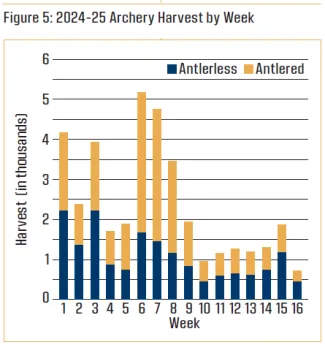
To offer additional insight, Figure 4 illustrates long-term trends in archery harvest and hunter participation, highlighting how the season has evolved over time. Figure 5 breaks down the archery harvest by week, offering a closer look at activity peaks and seasonal patterns in deer movement and hunter success.
MUZZLELOADER SEASON HIGHLIGHTS
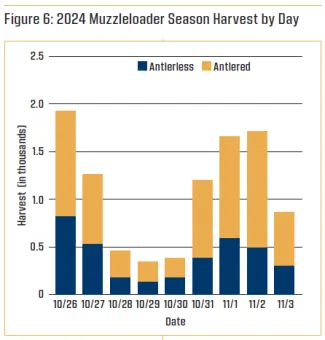
The 2024-25 muzzleloader deer season in Oklahoma spanned nine days, from Oct. 26 through Nov. 3. This season appeals to hunters who enjoy the unique challenge of using black powder firearms, and it continues to play a key role in the state’s overall deer management strategy.
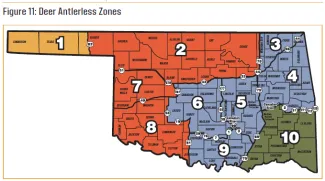
Hunters were allowed to harvest up to four deer, with regulations limiting the take to no more than one antlered deer. To further support population control and ensure ecological balance, enhanced bag limits were implemented in several designated antlerless deer zones. These measures were intended to encourage increased harvest of does in areas with higher deer densities. The boundaries and specific regulations for these zones are illustrated in Figure 11.
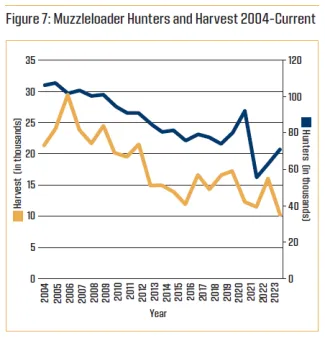
Compared to previous years, participation and harvest figures showed some fluctuation. According to the GHS, 70,677 hunters participated in the muzzleloader season. These hunters collectively harvested 10,580 deer.
To provide additional insight into hunter activity and harvest trends, Figure 6 presents a daily breakdown of deer harvested throughout muzzleloader season. The data help identify peak harvest days and can inform future management decisions. Figure 7 offers a historical perspective, charting muzzleloader harvest trends dating to 2004, allowing for long-term comparisons and analysis of participation patterns and harvest success over time.
OVERVIEW OF DEER GUN SEASON
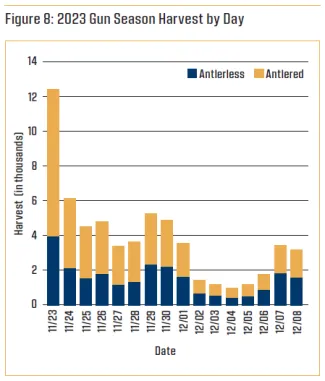
Oklahoma’s 16-day deer gun season continues to be a highlight of the hunting calendar. Last year, from Nov. 23 to Dec. 8, hunters were allowed to take up to four deer, with a restriction of one antlered deer, consistent with previous regulations.
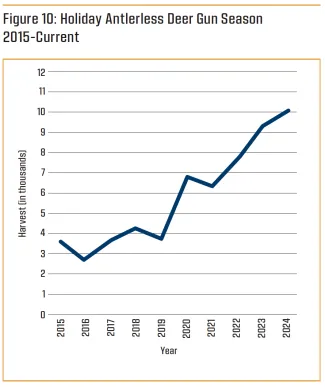
The combined gun seasons saw hunters harvest 79,008 deer, with antlerless deer making up 40% of the total. In addition, the youth deer gun season resulted in 4,736 deer harvested, while the holiday antlerless deer gun season added another 10,057 deer to the overall harvest.
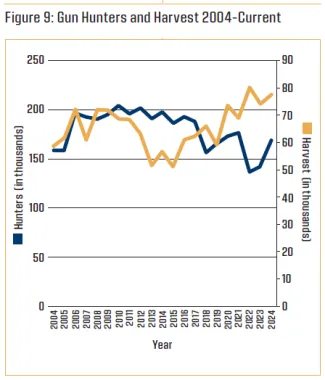
Detailed daily harvest data and long-term trends are illustrated in Figure 8 and Figure 9, and Figure 10 tracks the harvest history of the holiday antlerless season since 2015.
ASSESSING DEER AGE STRUCTURE
To effectively monitor the age composition of Oklahoma’s deer herds, ODWC relies on a variety of data sources that provide insight into the biological structure of the harvested population. These sources include voluntary participants in the Deer Management Assistance Program (DMAP), a cooperative program designed to assist landowners and managers in achieving habitat and deer management goals. Additional age data are collected through local meat processors, taxidermists, ODWC-controlled hunts, and public submissions through the department’s “Age My Deer” online tool — an accessible platform that allows hunters to submit photos and information to help determine the age of their harvested deer.
This multi-source approach provides a broad and representative sampling of deer from across the state, allowing wildlife biologists to evaluate the age distribution and overall condition of antlered and antlerless segments of the herd. Understanding the age structure is critical for assessing herd health, identifying management needs, and ensuring the sustainability of the deer population over time.
The information gathered is analyzed to track trends in herd maturity and to evaluate the effectiveness of current harvest strategies, particularly in promoting a balanced age structure with sufficient numbers of older, mature deer. These insights help guide future policy decisions and harvest recommendations.
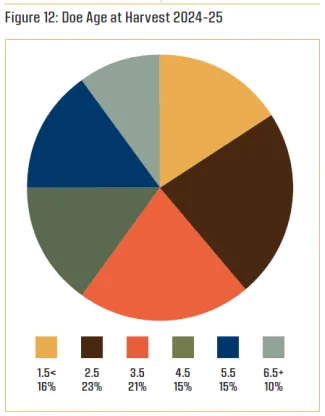
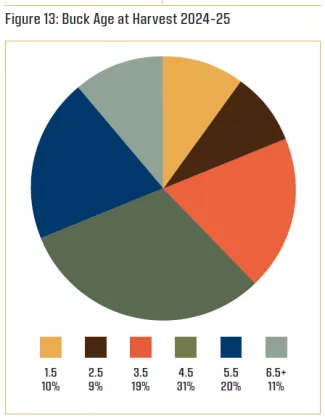
Figure 12 and Figure 13 illustrate the age breakdown of antlerless and antlered deer, respectively, harvested during the 2024-25 season. These figures provide a visual summary of the distribution across different age classes and offer valuable context for understanding the demographic makeup of Oklahoma’s deer herd.
MULE DEER
Oklahoma’s varied landscapes support a wide range of wildlife, and for deer hunters heading west, that includes the chance to pursue mule deer. These animals are scattered across the westernmost counties of the state, and locating one can be a real challenge. During the 2024-25 season, hunters harvested 209 mule deer — a decrease from the previous year.
In response to varying mule deer populations, ODWC has launched a groundbreaking research initiative. Using GPS collars and partnering with university researchers, managers are aiming to better understand mule deer behavior, fawn survival and movement in Oklahoma. Stay tuned for updates.
Mule deer harvest numbers are shown in Table 3.
Table 3: Mule Deer Harvest by County, Sex, and Method
Archery | Gun | Muzzleloader | |||||
|---|---|---|---|---|---|---|---|
| County | Antlerless | Antlered | Antlerless | Antlered | Antlerless | Antlered | Total |
| Beaver | 4 | 6 | 2 | 46 | 1 | 4 | 63 |
| Cimarron | 8 | 3 | 0 | 56 | 0 | 10 | 77 |
| Ellis | 0 | 2 | 0 | 7 | 0 | 0 | 9 |
| Harper | 0 | 2 | 0 | 8 | 0 | 4 | 14 |
| Roger Mills | 0 | 0 | 0 | 3 | 0 | 0 | 3 |
| Texas | 1 | 3 | 0 | 35 | 0 | 1 | 40 |
| Woodward | 0 | 0 | 0 | 3 | 0 | 0 | 3 |
| Grand Total | 13 | 16 | 2 | 158 | 1 | 19 | 209 |
For a recap of the 2024-25 big game seasons and some thoughts about this year’s hunting prospects, tune in at 8:30 a.m. Sept. 21, 2025, on the OETA network.
ELK SEASON HIGHLIGHTS
Oklahoma’s elk populations continue to show steady growth, both in terms of overall herd size and the geographic range they occupy. While the most substantial concentrations of elk remain in well-established strongholds, such as areas in the southwestern part of the state, sightings and successful harvests are now being reported in counties where elk presence was once rare or even historically absent. This expansion reflects the species’ adaptability and the success of ongoing habitat management and conservation efforts.
Elk hunting opportunities in Oklahoma are structured to ensure sustainable harvest while providing a unique hunting experience. Statewide elk hunting is permitted on private lands, provided hunters obtain written consent from the
landowner, a requirement that helps manage elk-human conflicts and protects landowner rights. In addition to private-land opportunities, the department offers drawings for controlled hunts, which take place on select public lands and are designed to carefully regulate hunting pressure and maintain healthy elk populations.
During the 2024-25 season, hunters harvested a total of 812 elk statewide. The majority of the harvest occurred in the Southwest Zone, which includes Kiowa, Comanche and Caddo counties — areas known for having the most established elk herds and consistent hunting opportunities. But the presence of elk in new areas of the state underscores the species’ ongoing range expansion and highlights the importance of monitoring efforts.
For a more detailed look at elk harvest data, including county-level breakdowns, sex of harvested animals, and harvest method (e.g., archery, muzzleloader or firearm), see Table 4. This summary provides valuable insight into the distribution and dynamics of elk hunting across Oklahoma, supporting data-driven wildlife management decisions.
Table 4: Elk Harvest by County, Sex, and Method
Archery | Gun | Muzzleloader | |||||
|---|---|---|---|---|---|---|---|
| County | Cow | Bull | Cow | Bull | Cow | Bull | Total |
| Adair | 0 | 0 | 0 | 2 | 0 | 0 | 2 |
| Beckham | 0 | 2 | 2 | 0 | 0 | 0 | 4 |
| Bryan | 0 | 0 | 0 | 1 | 0 | 0 | 1 |
| Caddo | 0 | 3 | 25 | 16 | 0 | 0 | 44 |
| Carter | 0 | 4 | 0 | 0 | 0 | 0 | 4 |
| Cherokee | 2 | 1 | 2 | 2 | 0 | 0 | 7 |
| Cimarron | 0 | 12 | 3 | 15 | 4 | 9 | 43 |
| Coal | 1 | 0 | 0 | 0 | 0 | 0 | 1 |
| Comanche | 28 | 25 | 364 | 151 | 7 | 4 | 579 |
| Dewey | 0 | 4 | 0 | 0 | 0 | 0 | 4 |
| Ellis | 0 | 1 | 0 | 0 | 0 | 0 | 1 |
| Grady | 0 | 0 | 1 | 0 | 0 | 0 | 1 |
| Greer | 0 | 0 | 0 | 3 | 0 | 0 | 3 |
| Johnston | 0 | 2 | 0 | 0 | 0 | 0 | 2 |
| Kiowa | 2 | 1 | 60 | 41 | 0 | 0 | 104 |
| Muskogee | 0 | 1 | 0 | 6 | 0 | 0 | 7 |
| Noble | 0 | 0 | 0 | 1 | 0 | 0 | 1 |
| Texas | 0 | 1 | 0 | 1 | 0 | 1 | 3 |
| Washita | 0 | 0 | 0 | 1 | 0 | 0 | 1 |
| Grand Total | 33 | 57 | 457 | 240 | 11 | 14 | 812 |
PRONGHORN SEASON SUMMARY
Oklahoma’s remarkable ecological diversity not only supports abundant deer and elk populations but also sustains a marginal population of pronghorn (Antilocapra americana), a species typically associated with the expansive grasslands of the western United States. In Oklahoma, pronghorn are primarily found in the wide-open rangelands of the Panhandle, which is the easternmost edge of their native range. Their presence here reflects the resilience of the species and the importance of maintaining open prairie ecosystems.
Due to the limited size and ecological sensitivity of Oklahoma’s pronghorn population, harvest opportunities are highly regulated to ensure the species remains sustainable within the state. Hunting is permitted through a three-pronged management system: over-the-counter archery permits for those seeking a challenging, low-impact method of take; controlled hunt drawings administered by ODWC, which allocate a small number of tags to applicants selected at random; and landowner-issued permits, which allow private landowners within designated pronghorn zones to participate directly in managing localized populations.
During the 2024-25 season, hunters harvested 89 pronghorns in the northwestern areas of the state. While modest in number, this harvest aligns with long-term management goals and reflects the careful balancing act between providing hunting opportunity and preserving a stable, regionally unique population of this iconic plains species.
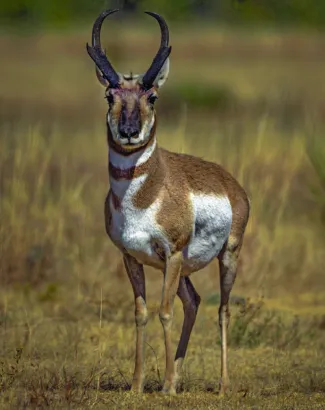
Table 5 offers a detailed breakdown of pronghorn harvest data, categorized by county, hunting method, and sex, providing insight into the spatial and demographic dynamics of pronghorn hunting in Oklahoma.
Archery | Gun | ||||
|---|---|---|---|---|---|
| County | Doe | Buck | Doe | Buck | Total |
| Cimmaron | 5 | 12 | 20 | 19 | 56 |
| Texas | 1 | 11 | 12 | 9 | 33 |
| Grand Total | 6 | 23 | 32 | 28 | 89 |
CHRONIC WASTING DISEASE (CWD) UPDATE
The 2024-25 big game hunting season marked the second consecutive year in which hunters in Oklahoma navigated new challenges following the detection of chronic wasting disease (CWD) within the state’s native wild deer populations. Initially identified in Texas County, and shortly thereafter confirmed in Woodward County, these developments prompted immediate concern among wildlife managers and the hunting community alike, given the serious implications CWD poses for deer health and population sustainability.
In response to this threat, ODWC implemented a series of additional regulations focused primarily on the northwestern region of the state, where CWD detections were concentrated. These regulations centered on restricting the movement of deer carcasses — a critical pathway for the potential spread of the prion disease — to reduce the risk of transmission to unaffected areas. Hunters in the affected counties were required to strictly adhere to specific
carcass transportation guidelines, including prohibitions on transporting certain parts of harvested deer outside designated zones, thereby helping to contain and slow the spread of infectious material.
To further support ongoing disease monitoring and early detection efforts, ODWC established a network of voluntary CWD testing sites, with five freezer drop-off locations strategically placed within Selective Surveillance Areas (SSAs). These sites provided convenient options for hunters to submit samples for CWD testing. During the 2024-25 season, several hunters took advantage of this opportunity, submitting samples that were all ultimately confirmed not detected for CWD, offering cautious optimism about the disease’s current prevalence in these areas.
Looking ahead, the carcass movement restrictions and testing programs are set to continue in SSAs for the 2025-26 season, reflecting a proactive and adaptive approach aimed at safeguarding the health and sustainability of Oklahoma’s deer herds. These efforts, combined with hunter cooperation and ongoing scientific monitoring, are essential components in managing this serious wildlife health issue.
CONCLUSIONS
As I reflect on this report, one message remains consistent: Oklahoma’s deer hunting community is thriving. Hunters are increasingly embracing their role as active managers of the deer population, particularly through sustained efforts to harvest appropriate numbers of antlerless deer. For the fifth consecutive year, the state met its management objective for antlerless harvest, supporting healthy and balanced deer populations.
Additionally, the average age of harvested bucks continues to indicate that hunters are adopting management strategies such as the “Hunters in the Know … Let Young Bucks Grow” philosophy. The quality of Oklahoma’s deer herds has improved markedly, with bucks now regularly featured in prominent hunting publications — a remarkable shift from times when simply encountering deer tracks was noteworthy. These achievements are largely the result of education and voluntary stewardship rather than increased regulation.
Looking ahead, challenges such as urban expansion, disease, overpopulation, and a declining hunting population will require ongoing attention. However, Oklahoma hunters have historically demonstrated resilience and a commitment to responsible wildlife management.
To those preparing for the 2025-26 season, consider mentoring new hunters and sharing knowledge. Remember, every decision made in the field impacts the health and sustainability of the local deer population.
Best wishes for a successful and enjoyable hunting season.
HUNTERS TAKE 77 BLACK BEARS DURING 2024 SEASONS
Black bear hunters had a great hunting season in 2024, taking a total of 77 (49 male and 28 female) bears, nine fewer than the year before.
Archery hunters took 74 black bears, while muzzleloader hunters bagged three bears in the bear hunting zone that includes all or portions of 12 counties in southeastern Oklahoma.
Choctaw Nation wildlife authorities conducted bear check-in for tribal members, accounting for seven (all archery) of the total 77 bears harvested.
The 2024 season was the first year that lifetime license holders were exempt from the purchase of a bear license. Of the 77 bears harvested, 44 were checked in by lifetime license holders. According to the cementum age analysis on premolars collected at check in, the average age of bears harvested in 2024 was observed to be about 3.5 years old.
In a testament to Oklahoma being a popular bear hunting destination, hunters from six other states took a black bear last year: 14 from Texas, one from South Dakota, one from California, four from Louisianan, one from Mississippi, and one from Kansas. Oklahoma hunters took 55 bears.
Bear hunters can expect this fall’s season to be similar to last year’s. Hunters who hunt over bait may find themselves competing with a good mast crop during the upcoming fall season. However, if predictions of extremely hot and dry late-summer weather are correct, a shortage of natural soft-mast food sources could lead to an increase in preseason bait site activity and consequently drive up harvest numbers in 2025.
Wildlife biologists offer these tips for increasing your chances of taking a black bear:
- Locate an area with fresh bear sign and stay there; you might have to sit all day or hunt multiple days.
- Start hunting as early in the season as possible.
- Stay weather-aware. Cold and wet conditions make bears less active.
- If the weather is hot, consider hunting near a water source.
- Bears will return to whatever food source is helping them gain the most weight. Acorns, especially from white oaks, are preferred by bears in non-bait areas.
- Start scouting for hunting spots in September.
All hunters wanting to pursue a black bear must buy either an archery or muzzleloader bear license before the opening dates of each season unless exempt. Archery bear season dates are defined in statute, as running from Oct. 1 until the third Sunday in October. In 2025, archery bear season will close at last legal shooting light on Oct. 19. Archery bear season has no harvest quota.
Muzzleloader bear season will open Oct. 25 and run through Nov. 2 or until the quota of 20 bears is reached. Before hunting, muzzleloader hunters must call for the latest bear quota information at 1-(888) 901-3256.
For more on black bear hunting, consult the Oklahoma Fishing and Hunting Regulations online, in the Go Outdoors Oklahoma mobile app for Apple and Android, or in print free at license dealers statewide.
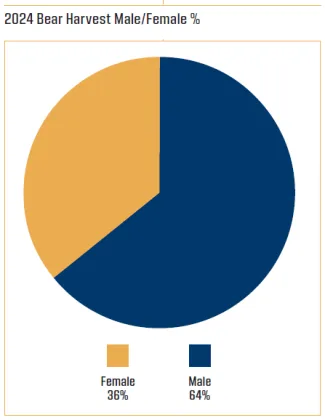
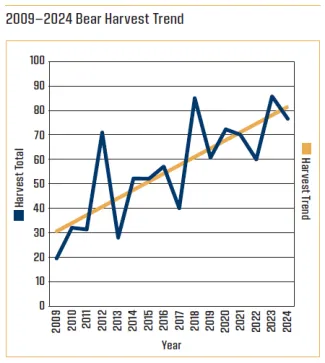
2024 Oklahoma Bear Harvest
Archery | Muzzleloader | ||||
|---|---|---|---|---|---|
| County | Male | Female | Male | Female | Total |
| LeFlore | 25 | 18 | 1 | 1 | 45 |
| Latimer | 9 | 2 | 0 | 0 | 11 |
| Pushmataha | 8 | 4 | 1 | 0 | 13 |
| McCurtain | 3 | 3 | 0 | 0 | 6 |
| Pittsburg | 2 | 0 | 0 | 0 | 2 |
| Grand Total | 47 | 27 | 2 | 1 | 77 |