Growing Success With Antlerless
’25-’26 Deer Hunting Harvest Second-Best in State History
The 2025-26 big game hunting season in Oklahoma marked another highly successful year for hunters statewide. Favorable environmental and habitat conditions again played key roles, creating ideal circumstances for wildlife populations and hunting opportunities.
Supported by strong and healthy game populations, those conditions contributed to a combined deer harvest of 133,791 animals, further demonstrating the continued strength and sustainability of Oklahoma’s big game resources.
This total ranks the 2025-26 season as the second most successful deer season in Oklahoma history based on total harvest numbers. The record remains the 2022–23 season, during which hunters harvested a combined total of 134,158 deer across all seasons.
Equally important was the continued commitment shown by Oklahoma hunters toward responsible wildlife management practices. Hunters across the state remained actively engaged in conservation-minded harvest efforts that support long-term herd health and sustainability.
One of the most notable achievements of the 2025-26 season was the percentage of antlerless deer harvested. Antlerless deer accounted for 45% of total harvest. This makes the sixth season in a row of achieving our antlerless harvest goal of 40% to 45% of the total harvest.
This antlerless milestone reflects a growing understanding among hunters of the importance of balancing herd dynamics, preventing overpopulation, and maintaining ecological stability. The Oklahoma Department of Wildlife Conservation’s (ODWC) “Hunters in the Know … Take a Doe!” public awareness campaign likely contributed to that success by encouraging hunters to play an active role in effective deer management.
In summary, more hunters made sound deer management decisions during the past season. The continued emphasis on harvesting antlerless deer represents more than a numerical achievement — it demonstrates a proactive and strategic commitment to the long-term conservation of Oklahoma’s deer herd.
By easing pressure on available habitat and food resources while helping maintain balanced buck-to-doe ratios, this management practice played a vital role in supporting strong and sustainable wildlife populations for future generations of hunters and outdoor enthusiasts.
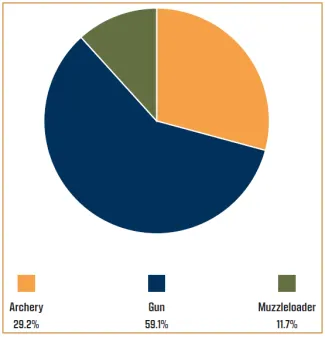
The firearm hunting seasons again accounted for the majority of the state’s overall deer harvest during the 2025-26 season. The modern gun season, youth gun season, and holiday antlerless season combined produced a total harvest of 79,071 deer. These firearm seasons remain the most productive hunting periods in Oklahoma due to their accessibility, strong participation rates, and effectiveness in supporting statewide deer management objectives.
The state’s nine-day muzzleloader season also delivered strong results, with hunters harvesting 15,636 deer. Popular among hunters who value traditional hunting methods and the added challenge of muzzleloading firearms, the season again proved to be a noteworthy contributor to Oklahoma’s annual harvest totals.
Archery season, which offers the longest opportunity afield and often appeals to hunters seeking a more strategic and immersive experience, accounted for an additional 39,084 deer harvested statewide. The continued success of archery hunters reflects both the growing popularity of bowhunting in Oklahoma and the effectiveness of archery equipment in skilled hands.
Taken together, these harvest figures demonstrate the diversity of hunting opportunities available across Oklahoma while underscoring the important role each season and hunting method plays in maintaining a balanced and sustainable deer population.
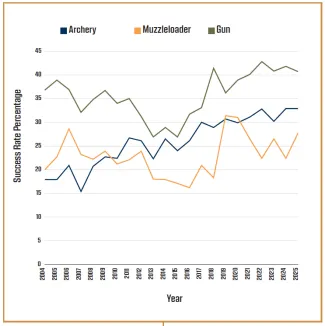
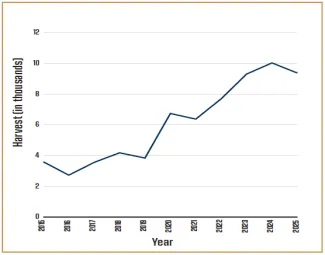
Figure 1 shows antlerless and antlered harvest trends over time. Figure 2 outlines hunter success rates by hunting method, while Figure 3 illustrates the proportional contribution each method made to Oklahoma’s total deer harvest.
Figure 1: Harvest Totals 2004-Current
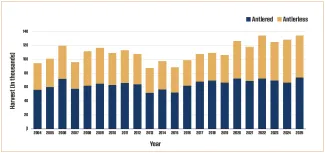
Figure 2 outlines hunter success rates by hunting method, while Figure 3 illustrates the proportional contribution each method made to Oklahoma’s total deer harvest.
Figure 2: Hunter Success Rates 2004 - Current
Oklahoma stands apart from many landlocked states because of its remarkable ecological diversity. From the dense pine forests and wetland habitats of the southeast to the expansive shortgrass prairies and sagebrush country of the northwest, the state encompasses a wide range of landscapes capable of supporting diverse wildlife populations.
Figure 3: Harvest by Method 2025-26
For deer hunters, this diversity creates an equally broad range of hunting experiences. Hunters are able to stand hunt or still hunt through heavily wooded river bottoms and hillsides or spot-and-stalk across open prairie landscapes.
These varying habitat conditions strongly influence deer distribution, population density, and overall hunting opportunities throughout Oklahoma. Local factors such as habitat quality, food availability, climate, and land-use practices all contribute to regional differences in deer populations, ultimately shaping harvest totals from county to county.
Also, access to public hunting areas influences hunting opportunity and harvest success. Focusing specifically on private-land harvest data offers a clearer picture of localized deer populations, hunting pressure, and harvest distribution within individual counties. To provide a more accurate representation of regional harvest trends, Table 1 highlights deer harvest totals per county while excluding deer harvested on public lands such as wildlife management areas. The top three counties for total deer harvested during the 2025–26 season were:
- Osage County, which led the state with 5,062 deer harvested and continued its long-established reputation as one of Oklahoma’s premier deer hunting regions.
- Pittsburg County, which recorded 3,975 deer harvested, reflecting the productivity and habitat quality found within southeastern Oklahoma
McCurtain County, which totaled 3,172 deer harvested, indicative of both a healthy deer population and strong hunter participation throughout the county.
Table 1: Harvest by County, Sex and Method
2025 Oklahoma deer harvest totals by county, method, and sex|
County
|
Archery | Gun | Muzzleloader |
Total
|
|||
|---|---|---|---|---|---|---|---|
|
Antlerless
|
Antlered
|
Antlerless
|
Antlered
|
Antlerless
|
Antlered
|
||
| County Total | 15,486 | 19,333 | 34,997 | 40,442 | 4,361 | 9,431 | 124,050 |
| Public WMA Total | 1,757 | 1,733 | 1,689 | 1,943 | 948 | 896 | 8,966 |
| OLAP Total | 379 | 396 | 0 | 0 | 0 | 0 | 775 |
| Grand Total | 17,622 | 21,462 | 36,686 | 42,385 | 5,309 | 10,327 | 133,791 |
Public Land Contribution
Although ODWC-managed lands, including WMAs and other public properties, comprise only about 4% of the state’s total land base, their contribution to the overall deer harvest is disproportionately high relative to their size. These areas provide critical access for hunters who lack private-land opportunities and are managed with an emphasis on habitat quality, wildlife conservation, and public hunting opportunity.
Despite their limited geographic footprint, ODWC-managed properties accounted for 6.7% of Oklahoma’s total deer harvest during the 2025–26 season. This notable performance underscores the effectiveness of public land management practices and the important role these areas play within the state’s diverse hunting landscape.
Many of these properties support productive deer populations through a combination of varied habitat types, active management techniques such as prescribed burning and food plot development, and carefully regulated hunting pressure. Together, these factors enhance habitat quality and contribute to consistent harvest success. In addition, public lands help ensure that hunting opportunities remain accessible and equitable, regardless of private land ownership.
Comprehensive public-land harvest numbers are presented in Table 2, providing a detailed breakdown of performance across individual WMAs and further illustrating the significant role these areas play in Oklahoma’s overall wildlife management strategy.
Table 2: WMA Harvest by Sex and Method
2025 Oklahoma deer harvest totals by Wildlife Management Area, method, and sex|
WMA Name
|
Archery | Gun | Muzzleloader |
Total
|
|||
|---|---|---|---|---|---|---|---|
|
Antlerless
|
Antlered
|
Antlerless
|
Antlered
|
Antlerless
|
Antlered
|
||
| Public WMA Total | 1,757 | 1,733 | 1,689 | 1,943 | 948 | 896 | 8,966 |
Archery Season Overview
The 2025-26 archery deer season again proved to be a major contributor to Oklahoma’s overall harvest, with hunters taking 39,084 deer statewide. Although this total fell short of recent record highs, it still represents a strong and consistent level of success, underscoring the continued growth and importance of bowhunting in Oklahoma.
A notable aspect of the archery harvest was its contribution to population management. Antlerless deer made up 43% of the total take by archers, reflecting a continued and intentional focus on doe harvest. This balance is central to sustainable deer management, helping stabilize herd growth and maintain healthy habitat conditions across the state’s varied ecosystems.
Participation levels remained high throughout the season, with an estimated 109,810 archery hunters afield, according to ODWC’s Game Harvest Survey (GHS). This long-running survey serves as a key tool for tracking participation and harvest trends across all hunting seasons and methods.
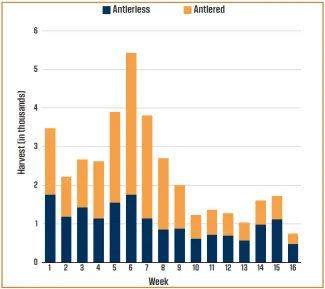
Running from Oct. 1, 2025, through Jan. 15, 2026, the archery season provided the longest uninterrupted deer hunting opportunity in the state, spanning more than three months. Regulations allowed for the harvest of up to six deer per hunter, with a maximum of two antlered deer, offering flexibility while still supporting statewide management goals. To further illustrate seasonal dynamics, Figure 4 highlights long-term trends in both archery harvest and participation, showing how the season has changed over time. Figure 5 provides a weekly breakdown of harvest activity, offering insight into peak periods of movement and hunter success patterns throughout the season.
Figure 4: Archery Hunters and Harvest 2004-Current
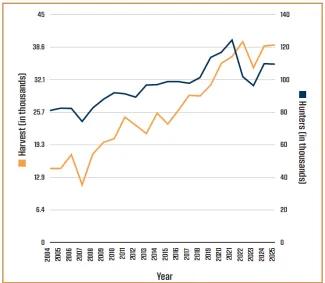
Figure 5: 2025-26 Archery Harvest by Week
Muzzleloader Season Highlights
The 2025-26 muzzleloader deer season ran for nine days from Oct. 25 through Nov. 2. This season again attracted hunters who appreciate the added challenge and traditional appeal of black powder firearms and served as an important component of Oklahoma’s comprehensive deer management framework.
Hunters were permitted to harvest up to four deer, with a restriction of no more than one antlered deer per participant. In addition, enhanced bag limits were applied in select antlerless deer zones to further support population management efforts in areas with higher deer densities. These targeted regulations were designed to encourage increased doe harvest where needed to maintain ecological balance. The specific boundaries and regulations for these zones are shown in Figure 11.
Figure 11: Antlerless Deer Zones

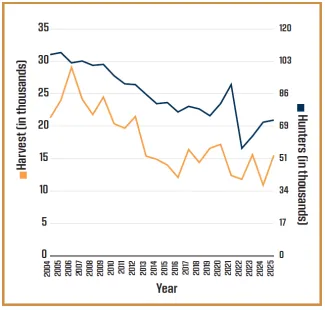
Participation in the season totaled 70,537 hunters (according to the GHS) who collectively harvested 15,636 deer statewide. This was a significant upswing compared to 2024-25 season harvest of 10,580.
For further context, Figure 6 provides a daily breakdown of muzzleloader harvest activity, highlighting fluctuations in hunter success and identifying peak harvest periods throughout the season. Figure 7 presents a long-term view of muzzleloader harvest trends dating to 2004, offering valuable insight into changes in participation and harvest outcomes over time.
Figure 6: 2025 Muzzleloader by Day
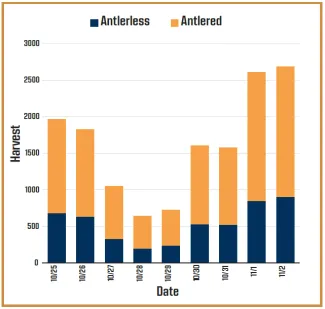
Figure 7: Muzzleloader Hunters and Harvest 2004-Current
Deer Gun Season Overview
Oklahoma’s deer gun season, always a key part of the state’s hunting traditions, ran for 16 days from Nov. 22 through Dec. 7. This past season followed the same structure as previous years, which allowed hunters to harvest up to four deer, with a restriction of one antlered deer.
When youth deer gun, deer gun, and holiday antlerless deer gun seasons are combined, hunters harvested 79,071 deer statewide. Antlerless deer accounted for 46% of that total. The youth deer gun season contributed 3,669 deer, and the holiday antlerless deer season accounted for 9,366 deer in the overall gun harvest.
Figure 8 and Figure 9 provide a breakdown of daily harvest activity and long-term trends, while Figure 10 highlights the harvest history of the holiday antlerless season dating to 2015.
Figure 8: 2025 Gun Season Harvest by Day
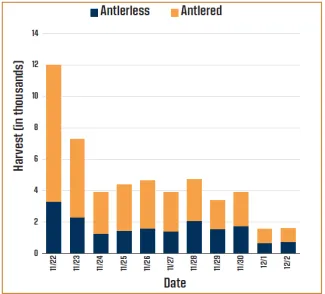
Figure 9: Gun Hunters and Harvest 2004-Current
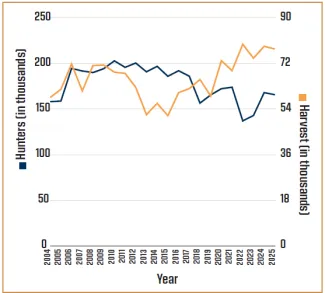
Figure 10: Holiday Antlerless Deer Gun Season Harvest 2015-Current
Evaluating Deer Age Structure
To monitor the age composition of Oklahoma’s deer population, ODWC uses multiple data sources that together provide a detailed picture of the overall harvest. One key source is the Deer Management Assistance Program (DMAP), a voluntary, cooperative effort that helps landowners and wildlife managers meet specific habitat and herd management objectives.
Age data are also gathered from several additional channels, including local meat processors, taxidermists, ODWC-managed hunts, and public submissions through ODWC’s “Age My Deer” online tool, which allows hunters to upload photos and harvest information for age estimation.
By combining these sources, biologists are able to build a broad and representative sample of deer across the state. This information is used to evaluate the age distribution and overall condition of both antlered and antlerless segments of the population.
Understanding age structure plays an important role in assessing herd health, identifying management priorities, and supporting long-term population sustainability. The resulting analysis helps track changes in herd maturity over time and measures the effectiveness of current harvest strategies, especially when evaluating age structure to maintain a healthy proportion of older, mature deer. These findings directly contribute to future management decisions and harvest recommendations.
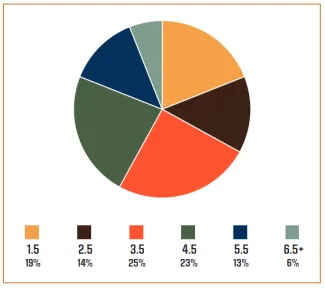
Figure 12 and Figure 13 present the age-class breakdown of antlerless and antlered deer harvested in 2025-26, offering a clear visual representation of the herd’s age distribution and overall demographic structure.
Figure 12: Doe Age at Harvest 2025-26
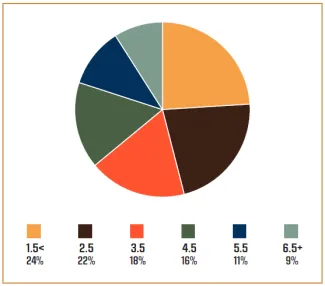
Figure 13: Buck Age at Harvest 2025-26
Mule Deer
Oklahoma’s diverse terrain supports a wide variety of wildlife species, including mule deer. These deer are primarily found in the far western counties, where sightings can be limited and hunting often presents significant challenges.
In the 2025-26 season, hunters harvested 294 mule deer, an uptick compared to 2024-25 season’s 209.
To better understand and manage mule deer populations, ODWC is completing a three-year collaborative research project that uses GPS collars to study movement, fawn survival rates, and overall behavior. Results from this study will provide information needed to bolster management of this species within Oklahoma. Harvest totals for mule deer are presented in Table 3.
Table 3: Mule Deer Harvest by County, Sex, and Method
2025 Oklahoma mule deer harvest totals by county, method, and sex|
County
|
Archery |
Gun Antlered
|
Muzzleloader Antlered
|
Total
|
|
|---|---|---|---|---|---|
|
Antlerless
|
Antlered
|
||||
| Grand Total | 8 | 30 | 225 | 31 | 294 |
Elk Season Highlights
Oklahoma’s elk population continues to expand gradually, both in number and density in currently occupied areas.
While the highest concentrations remain in established strongholds — particularly in the southwestern region — elk are increasingly being observed and harvested in counties where they were once uncommon or historically absent. This pattern reflects both the species’ adaptability and the continued success of habitat conservation and management efforts. At the same time, increasing reports of elk in new areas highlight the ongoing spread of the species and the importance of continued monitoring.
Elk herds in Oklahoma are managed to balance hunting opportunity with long-term sustainability. Hunting is allowed on private land statewide with written permission from landowners, helping ensure responsible harvest and respect for property rights while reducing potential land-use conflicts. The state also conducts controlled hunts on select public lands through a draw system, which regulates pressure and helps maintain stable herd conditions.
In the 2025-26 season, hunters harvested 844 elk across the state. Most were harvested in the Special Southwest Zone (Kiowa, Comanche and Caddo counties), where established herds continue to support consistent hunting opportunities.
A detailed breakdown of elk harvest data, including county distribution, sex of animals taken, and harvest method, is available in Table 4. This information provides a clearer picture of harvest patterns and supports informed wildlife management decisions.
Table 4: Elk Harvest by County, Method and Sex
2025 Oklahoma elk harvest totals by county, method, and sex|
County
|
Archery | Gun | Muzzleloader |
Total
|
|||
|---|---|---|---|---|---|---|---|
|
Antlerless
|
Antlered
|
Antlerless
|
Antlered
|
Antlerless
|
Antlered
|
||
| Grand Total | 42 | 53 | 436 | 284 | 13 | 16 | 844 |
Pronghorn Season Summary
Pronghorn among the more unusual big game species in Oklahoma, which is the eastern edge of their historic range. They are largely confined to the open grasslands of the Panhandle, where suitable habitat still resembles the wide, sparsely vegetated plains the species depends on.
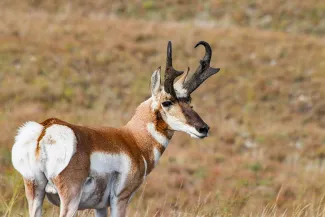
Given their limited distribution and relatively small population size, pronghorn harvest in Oklahoma is tightly regulated. Hunting opportunity is provided through a combination of archery permits available over the counter, draw hunts through ODWC’s controlled hunts program, and landowner-issued permits within designated areas open to hunting. This structure is designed to distribute opportunity while maintaining careful oversight of the pronghorn population.
During the 2025–26 hunting season, 80 pronghorn were harvested in the Panhandle. While the harvest remains low compared to other big game species, it is consistent with management goals aimed at sustaining a stable, localized population.
A complete breakdown of pronghorn harvest data is presented in Table 5.
Table 5: Pronghorn Harvest by County, Method and Sex
2025 Oklahoma pronghorn harvest totals by county, method, and sex|
County
|
Archery | Gun |
Total
|
||
|---|---|---|---|---|---|
|
Does
|
Bucks
|
Does
|
Bucks
|
||
| Grand Total | 1 | 13 | 36 | 30 | 80 |
Chronic Wasting Disease (CWD) Update
The 2025-26 big game season marks the third consecutive year Oklahoma hunters and wildlife managers have operated under new management considerations following the detection of chronic wasting disease (CWD) in the state’s wild deer populations. The disease was first confirmed in wild free-ranging deer in Texas County and later detected in Woodward County, prompting ongoing concerns due to its potential long-term impacts on deer health and herd sustainability.
In response, ODWC maintained and refined targeted regulations in northwestern Oklahoma, where previous detections have been concentrated. These measures continue to focus on carcass transport restrictions, a critical tool for reducing the risk of spreading infectious prions. Hunters in affected areas are required to follow specific guidelines limiting the movement of certain deer parts outside designated zones, helping reduce the likelihood of disease transmission into unaffected regions.
For the 2025-26 season, ODWC also established a new Selective Surveillance Area (SSA) in McCurtain County. This addition was prompted by the confirmation of a CWD-positive deer harvested in Arkansas within five miles of the Oklahoma border, highlighting the importance of proactive monitoring along state boundaries and potential risk corridors.
A CWD-positive deer was tested in Cimarron County, marking the first hunter harvested CWD-positive deer in the state. This positive deer was harvested within an established SSA, and its location of harvest did not result in the expansion or establishment of another SSA.
To support continued surveillance and early detection, ODWC maintains voluntary testing opportunities within SSAs through a network of freezer drop-off locations. These sites allow hunters to submit samples for CWD testing as part of the broader monitoring effort.
Carcass movement restrictions and voluntary testing programs will continue into the 2026-27 season. Together with hunter participation and ongoing scientific monitoring, these measures create a proactive approach aimed at limiting the spread of CWD and safeguarding the long-term health of Oklahoma’s deer populations.
Go to Selective Surveillance Areas (SSA)
Conclusions
Another round of big game hunting seasons is in the books, and Oklahoma hunters again proved they are among the most dedicated conservationists in the country. The success of the state’s deer herd today is not the result of chance — it's the product of thousands of hunters making thoughtful decisions season after season.
Over the years, we've watched Oklahoma's deer herd transform. What once was a restoration success story has become one of the nation's premier deer management achievements. Healthy populations, balanced sex ratios, and an increasing number of mature bucks on the landscape are all signs that hunters are taking an active role in shaping the future of the resource.
This past season continued that trend. Hunters remained committed to harvesting antlerless deer where needed, helping keep local populations in balance with available habitat. At the same time, many hunters continued to pass on young bucks, allowing more deer to reach older age classes and contributing to improved age structure and the quality of hunts across the state.
Of course, our work is never finished. Oklahoma's landscapes and communities continue to change, bringing new challenges and opportunities for wildlife management. Disease concerns, habitat losses, increasing development, and declining participation in hunting are issues that will require attention in the years ahead. Meeting those challenges will depend on the same qualities that have brought us this far: stewardship, adaptability, and a willingness to invest in the future.
As preparations begin for the 2026-27 season, I encourage every hunter to think beyond the next harvest. Introduce someone to hunting. Share a campfire story with a young hunter. Teach safe and ethical hunting practices. The traditions we pass along today will determine the strength of Oklahoma's hunting heritage tomorrow.
Thank you for your continued support of wildlife conservation and responsible deer management. Whether your season is measured by a filled tag, time spent with family and friends, or simply a sunrise from a deer stand, I hope the coming year provides memories that last a lifetime.
Good luck, hunt safely, and enjoy the season ahead.
Hunters Take 54 Bears
By Matt Hensley
Senior Wildlife Biologist
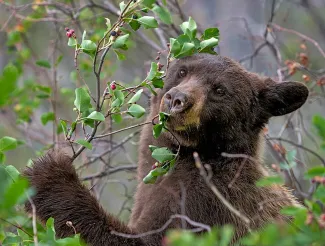
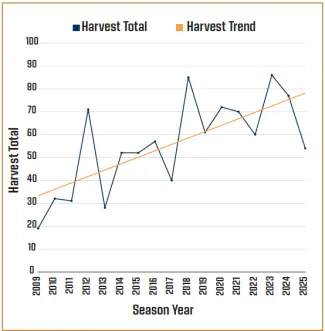
In State’s 2025 Season Hunters took 54 black bear (28 males and 26 females) in Oklahoma in 2025, 23 fewer than the year before.
The drop in harvest is largely attributed to an exceptional, early falling mast crop that made hunting over bait less effective. Because most hunter effort is spent hunting over bait, harvest rates are consistently affected by the natural abundance or shortage of the fall mast crop.
Archery hunters took 49 black bear, while muzzleloader hunters bagged five bear in the open zone that includes all or portions of 12 counties in southeastern Oklahoma that are south of Interstate 40 and east of U.S. 69.
2009-2025 Bear Harvest Trend
Choctaw Nation wildlife authorities handled bear check-in for tribal members, checking in four (all archery) of the total harvested. Analysis on premolars collected at check-in showed the average age of bear taken in 2025 was
about 3.1 years old.
Oklahoma is a bear hunting destination; in addition to the 44 resident hunters who bagged a black bear in 2025, there were seven from Texas, one from Arkansas, one from Alabama, and one from the United Kingdom.
This fall’s season is expected to be similar to last year’s. Hunters sitting over bait may find themselves competing with the natural mast crop. However, a low-producing or late-falling mast crop could lead to an increase in bait site activity and consequently drive up harvest numbers in 2026.
The 20-bear muzzleloader quota has been removed, so hunters are no longer required to call and check the day’s quota status before hunting.
Wildlife biologists offer these tips for increasing your chances of taking a black bear:
- Start scouting for hunting spots in September.
- Bears will return to the food source helping them gain the most weight. Acorns, especially from white oaks, are preferred.
- Hunt as early in the season as possible.
- Be scent savvy; bears have an exceptionally keen sense of smell.
- Be patient and persistent; you might have to sit all day or multiple days.
- Stay aware of the weather. Cold, wet conditions make bears less active.
- If the weather is hot and dry, consider hunting near a water source.
Hunters wanting to pursue a black bear must buy either an archery or muzzleloader bear license before that season opens, unless exempt. Archery bear season is Oct. 1 through the third Sunday in October (which is Oct. 18 this year). Muzzleloader bear season will open Oct. 24 and close Nov. 1. There is no longer any harvest quota for any black bear season.
For more on black bear hunting, consult the Oklahoma Fishing & Hunting Regulations online, in the Go Outdoors Oklahoma mobile app for Apple and Android, or in print free at license dealers statewide.
Bear Harvest by County, Method and Sex
2025 Oklahoma bear harvest totals by county, method, and sex|
County
|
Archery | Muzzleloader |
Total
|
||
|---|---|---|---|---|---|
|
Male
|
Female
|
Male
|
Female
|
||
| Grand Total | 25 | 24 | 3 | 2 | 54 |