While I’m working in my job for the Wildlife Department, I’m frequently asked, “Are you a game warden?” I respond with, “No, I am actually a wildlife biologist for the state of Oklahoma, and I can also answer your questions.”
Most times this prompts the question, “What does a wildlife biologist do?”
What if I were to ask you the question, “What does an Oklahoma biologist do?” Would you picture an individual dressed in a white lab coat looking through a microscope? Or an individual sitting at a computer entering biological and statistical data?
Would you also picture an individual wearing firefighting gear, working a controlled burn that is part of a prescribed fire plan? Or maybe an individual flying in an airplane or sitting in a pickup looking out the window with binoculars to survey animal populations and animal distribution across the landscape?
If your answer was yes to any of these, then you are correct. But these are just a few examples of the vast responsibilities and tasks that an Oklahoma wildlife biologist handles.
When you look up the definition of a wildlife biologist, it says “a professional who studies wild animals and their interaction with their environment.”
The Human Resources staff at the Oklahoma Department of Wildlife Conservation (ODWC) has considered the question and has separated the profession into 10 different types of Oklahoma wildlife biologists.
Work for Wildlife
Interested in applying for a position with the Oklahoma Department of Wildlife Conservation? Current openings are listed on the ODWC website.
Here are those 10 types, with brief descriptions of what the biologist is in charge of and the unique job tasks and responsibilities assigned to them.
The number of biologists for each type currently employed by ODWC is shown in parentheses.
- Wildlife Diversity Biologist (2): Provides management and research recommendations and guidance regarding species of greatest conservation need. Also provides biological, ecological, and taxonomic expertise regarding management and conservation actions benefiting rare and declining species. Conducts audio and visual wildlife surveys by day and night, and accurately observes, records, and analyzes scientific data and prepares and submits detailed reports.
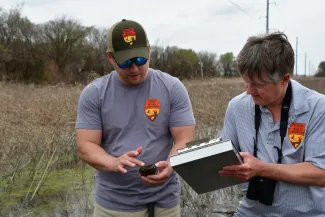
- Wetlands and Waterfowl/Migratory Birds Biologist (1): Plans, develops and guides statewide management of migratory bird programs including waterfowl and other migratory game birds as well as plans, develops, and permits wetland habitat projects. Works directly with the U.S. Fish and Wildlife Service and the international Central Flyway Council to direct research and regulations including bag limits and season dates within the federal Migratory Bird Treaty Act framework.
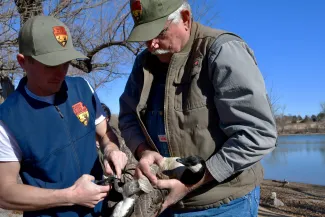
- Big Game Biologist (1): Plans, develops, and guides statewide management of big game programs focused on white-tailed deer, mule deer, elk, and pronghorn. Manages collection of population and harvest data to develop and implement short- and long-range management needs across various habitats and species and formulates regulations including bag limits and season dates.
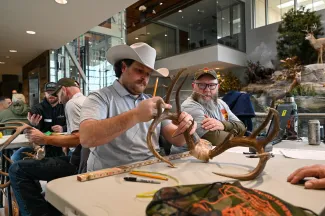
- Upland Game Biologist (1): Plans, develops, and guides statewide management of upland game birds program and manages data collection to develop regulations and guidance including bag limits and season dates, provides hunting season forecasts and other outreach items to the public.
- Research Biologist (1): Develops, plans, and conducts scientific research projects using currently approved resource management methodology, including accurately collecting and analyzing data, formulation of statistically sound conclusions, presenting findings to stakeholders and at technical meetings, and disseminating research through the peer-review publication process.
- Oklahoma Land Access Program (OLAP) Biologist (1): Develops and implements access program goals, objectives, and habitat/hunt quality evaluation protocols for OLAP. Purchases and maintains signage, supplies and equipment, and conducts routine maintenance on properties. Develops program outreach materials and conducts landowner outreach and solicitation through direct mailings, online news releases, public meetings, door-to-door contacts and referral processes.
- Private Lands Biologist (5): Works extensively with private landowners, other partners, and interested public to provide technical guidance, wildlife and habitat management recommendations and plans, and interpret habitat management specifications and policies. Serves as agency representative or liaison on one or more technical committees, organization, and/or special emphasis programs/projects.
- Furbearer Biologist (1): Plans, develops, and guides statewide management of the agency fur bearing species program, manages data collection to develop regulations and guidance including bag limits and season dates, manages all mountain lion sighting reports including field investigations, confirmations, and necropsy of collected cats. In addition, manages all aspects of the state falconers permitting and regulatory process and ensures agency compliance with federal falconry regulations.
- Threatened and Endangered Species (T&E) Biologist (1): Assists in establishing project goals and participates in the development of the Wildlife Diversity section objectives. Administers the agency’s Section 6 Grant Program and works with partners to develop and complete relevant Section 6 projects. Coordinates agency comments and official position letters in response to Federal Register notices related to threatened and endangered species.
And finally, my favorite type:
- Wildlife Management Area (WMA) Biologist (31): Has primary responsibility for the management of and is the primary point of contact for the WMA(s) assigned to him or her. Proactively manages wildlife and native plant communities, and operates and maintains facilities, equipment, infrastructure and lands, including wetlands/wetland development units and shooting ranges within assigned WMA(s). Serves as burn boss for WMA prescribed burning program, designs, implements and monitors agriculture, grazing, hay and/or timber leasing or harvest programs.
In addition to those responsibilities described above, most of the positions require the biologist to prepare and submit annual project budgets including salaries, equipment, supplies, maintenance, etc. for assigned projects; supervise full-time and temporary employees, use GIS for data entry, management and analysis, and for monitoring, planning and reporting management activities and results; draft and review State Wildlife Grants and Wildlife Restoration Grant package components and opportunities. Wildlife biologists also help draft and review Oklahoma hunting rules and regulations.
Most importantly, biologists work with the public face-to-face, answering a wide variety of questions in a wide variety of situations and venues, from interactions on the WMAs, to interactions in communities at the local gas stations or at one of ODWC’s many outreach educational events.
You might have noticed from the descriptions above that some positions have only one person serving the entire state of Oklahoma. That makes it critical for all Oklahoma biologists to work together and assist each other to accomplish their respective job duties.
Across the state of Oklahoma, there are only 45 wildlife biologist positions within ODWC. They all have to meet specific requirements and require a wide range of knowledge.
So, what does a wildlife biologist do? It’s a little more than just wearing a white lab coat.
About the Author
John Rempe has devoted 28 years to ODWC, starting as an intern at Canton WMA before serving as a technician at Beaver WMA, where he was named Technician of the Year in 1999. He has been the wildlife biologist at Hulah WMA the past 20 years and now manages nearly 35,000 acres at Hulah, Copan, and Osage WMAs. This year, he was honored as Wildlife Biologist of the Year.