Oklahoma Department of Transportation natural resources biologists found creative ways to minimize the impact of a Panhandle bridge construction project on the state’s largest known maternity colony of Yuma bats, while also restoring habitat on the newly rehabilitated bridge. More than 700 female bats and pups have been counted by thermal camera as they emerged from the bridge’s newly installed artificial roost panels, a testament to the team’s innovation and dedication to their work.
To motorists traveling on Oklahoma’s highways and interstates, a bridge may be nothing more than a literal bump in the road; forgotten as soon as it’s crossed. But to natural resources biologists with the Oklahoma Department of Transportation (ODOT), the roughly 6,800 structures maintained by the state not only provide vehicles a place to easily cross streams and rivers but also provide bats and other wildlife a place to live.
“Bridges can provide great habitat for bats,” said Phillip Crawford, one of eight natural resources staff contracted to ODOT by the University of Oklahoma. “There are usually plenty of 2-inch or smaller cracks and crevices that provide protection from wind, sunlight, and predators.”
Image
Jena Donnell/ODWC
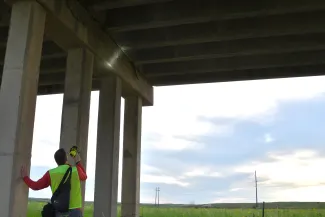
Phillip Crawford has traveled every mile of Oklahoma’s state highway system in his 23-year career surveying for wildlife that may be using transportation structures. To look for roosting bats, he shines a powerful spotlight into crevices and flaking concrete.
In addition to a trifecta of bat protection services, the underside of a bridge also warms with the sun, creating toasty spaces that the nocturnal mammals prefer. And most Oklahoma bridges are engineered to last 70 – 80 years, giving bats a relatively permanent spot to roost near the waterways they often forage over for flying insects.
But bridges require maintenance, and every structure eventually needs to be rebuilt.
Crawford has spent the bulk of his 23-year career conducting wildlife surveys and ensuring protected wildlife species like migratory birds and threatened and endangered bats are not impacted by transportation construction projects. While most of his work has been in the eastern one-third of the state – where more threatened and endangered bat species occur – Crawford has driven every mile of state highway in his ODOT role and was asked to visit an ongoing bridge construction project in Oklahoma’s Panhandle in 2023.
As with many bridge construction projects, signals had been installed at each end of the bridge and traffic narrowed to one lane. Crews had demolished and rebuilt one lane of the bridge and were ready to redirect the one-lane traffic so they could begin work on the other side. The district engineer – responsible for highway maintenance and construction activities for nine counties in northwestern Oklahoma and the Panhandle – asked Crawford to conduct a wildlife survey to make sure the next half of the project could continue as scheduled.
But Crawford found that cliff swallows, birds that are federally protected by the Migratory Bird Treaty Act, had returned to the state and built their mud nests on the to-be-demolished side of the bridge sometime between the start of the project and this half-way point. The bird’s presence was reported to the U.S. Fish and Wildlife Service but would only cause a minor project delay as it was near the end of the protected nesting season.
Crawford also noticed a surprising number of bats using the remaining underside of the old bridge. Both female bats and pups were documented using the site, indicating the bridge was home to a maternity colony.
“Right away, I could hear bats and smell guano,” recalled Crawford.
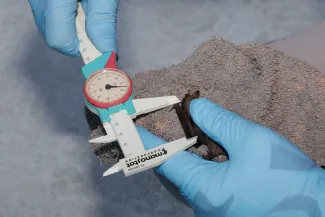
Initially, Crawford suspected the bats were cave myotis, a species that regularly uses Oklahoma’s western caves and man-made structures. Using calipers, he measured the bat’s forearm, ear length, and total body length to try to confirm the identification. But the measurements were too small for a cave myotis. In fact, they weren’t right for any species commonly found in the state.
Image
Oklahoma Department of Transportation
Crawford took measurements of bats roosting on the underside of the bridge to help with the identification process.
“The photos, the measurements of bats in hand – it was all wrong.” Crawford said. “The bats were too small to be cave myotis.”
Regardless of the challenging identification, none of the bat species that occur in Oklahoma’s Panhandle are currently protected by the Endangered Species Act, nor are they regulated by the State of Oklahoma. Ultimately, the bat’s presence wouldn’t necessitate a delay for the project, and construction could legally resume after the cliff swallow’s nesting season.
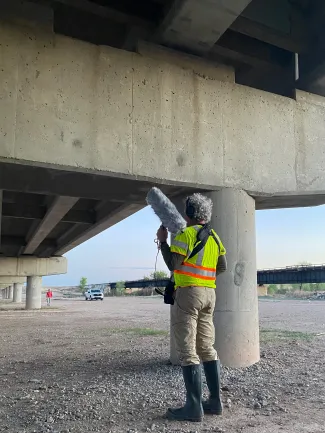
After conferring with colleagues in other organizations Crawford tentatively identified the group as a maternity colony of Yuma bats. Seeking additional evidence, he and coworker Randy Soto returned to the site and used ultrasonic microphones to record echolocation calls as the bats emerged from their roosts on the bridge to confirm the colony as one of Yuma bats, an unusual species for the state.
Image
Oklahoma Department of Transportation
ODOT’s Randy Soto, who helped with the identification process, also used a microphone to listen for low-frequency bat chatter to determine which of the installed artificial roost panels may be occupied by bats.
“This was the first Yuma bat record tied to a bridge in Oklahoma, and the first record of a Yuma bat maternity colony using a transportation structure in the State,” Crawford said. “It’s by far the largest known maternity colony of Yumas in Oklahoma – at least the largest colony to which I can find reference in the published literature.
More About Yuma Bats
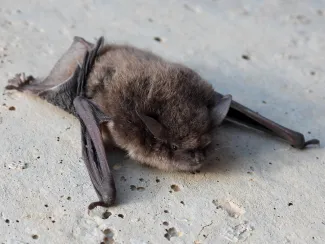
Like many other North American bats, the Yuma bat is small in size, brown in color, and primarily an insect eater. To distinguish it from other small, brown bats in the state, biologists typically rely on a combination of skull, wing, feet, and ear measurements, as well as the species’ known range and echolocation call patterns.
Image
Oklahoma Department of Transportation
The Yuma bat measures about 1.5 – 2 inches in length, with the tail extending another 1 – 1.5 inches. The hind foot is noticeably large, measuring about half the length of the lower leg bone. Coloration is variable, but the bats found in Oklahoma are often paler brown above with a cream belly. Though considered an arid lands bat, its location is often tied to open water like permanent streams and rivers over which it forages for moths, beetles, flies, and other insects. Oklahoma’s Panhandle lies on the far eastern edge of the Yuma bat’s range, which extends from Canada to Mexico in the western U.S.
As with other North American bats, Yuma bats mate in the fall, and the sperm remains dormant in the females until spring. Females give birth to one pup a year and newborns are about 20% of the mother’s weight. The average lifespan is about 5 years in the wild, meaning females may only produce up to four young in their life. Natural roosts include caves and cliffs, hollow trees, and under loose pieces of bark, but the species often adopts man-made structures, including buildings and bridges.
Though construction work could legally continue, Crawford and his coworkers recognized the vulnerability of the Yuma bat maternity colony and looked for ways to mitigate and minimize disturbance.
“We knew that ‘fall swarming’ – when the bats move from their summer roosts to either migrate or transition to hibernation sites, happened in mid-October,” said Amber McIntyre, Natural Resources Program Manager for ODOT’s Environmental Programs Division. “And we knew this colony’s pups were already volant, or capable of flight. So, we started looking for ways to exclude the colony from the bridge. To get the bats to move away from the bridge a little earlier than normal.”
With the contractor’s permission, the team used a man lift to safely reach the side of the bridge. Working at night after the bats had left for their nightly foraging session they scraped old cliff swallow nests from the bridge as bats had been seen roosting in the abandoned gourd-shaped mud nests. They also blocked the expansion joints and other bridge crevices with foam backer rod, pipe insulation, and pool noodles.
“We bought out the local hardware store of pipe insulation, and then the local Dollar General of pool noodles,” McIntyre said.
The bats eventually took the hint that their summer home was closed for renovations, and bridge construction resumed.
“We could have left it there,” McIntyre said.
But Crawford was focused on the importance of the bridge as a maternity site for a species of bat unusual to the state.
“These bats only have one young per year,” Crawford said. “If you disturb one colony – even just for a few years – you may lose most members of the species in the state. At this point, every bat is important.”
Crawford and McIntyre knew the new bridge design had wider expansion joints that didn’t offer the same quality of bat roosting experience, and that Departments of Transportation in more and more states were designing artificial bat roosts into structures. They approached the contractor and bridge engineer, who were agreeable to adding a structure to the new bridge.
“But with a government agency, you can’t just proceed with one ‘yes,’” said McIntyre. There were conversations at multiple levels, and the added cost of the artificial roosting structures and their installation – though minimal – had to be added to the project’s purchase order.
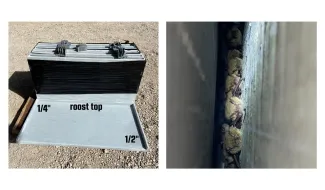
In the end, a total of 20 artificial roost panels were added to four of the bridge’s 10 piers. Installation happened over the winter, and the Natural Resources Program had to wait months to see if the colony would return to the bridge and use the new roost panels.
Image
The artificial roost panels were designed to be enclosed on three sides, with varying depths so that when installed on a flat surface, bats may select their preferred roosting site and shift positions as roosting temperatures change.
“It was pretty cool,” said Crawford, thinking of his first visit to the bridge in the spring of 2024 and realizing the bats had adopted the structures. More than 700 Yuma bats were documented emerging from the panels that first year.
“I cried,” McIntyre admitted. “I didn’t realize how much we were holding our breath that this would work.
“I’m so proud of Phillip. This bridge is just one example of the work he’s doing across the state. I have to credit him for focusing on the site. For recognizing that this is a regionally important site for the species and taking action.”
McIntyre has since taken the success story to other ODOT districts, reinforcing the important role transportation can play in wildlife conservation, and is getting interest and even enthusiasm for incorporating the artificial roost panels on future projects still in the design phase.
“This was all voluntary,” said McIntyre. “They didn’t have to delay the project for the bats or figure out how to incorporate the panels in the new design. This work was done because the people wanted to do it.”

 Oklahoma Department of Transportation