Almost as soon as the fair weather hawks fade into summer’s memories, a new set of hawks are landing in our state. Four hawk species regularly join Oklahoma’s three year-round residents by mid-fall to make the most of our state’s relatively mild winters and abundant food sources.
Improve your winter hawk-watching with the following identification tips:
Red-tailed Hawk
Year-round Resident
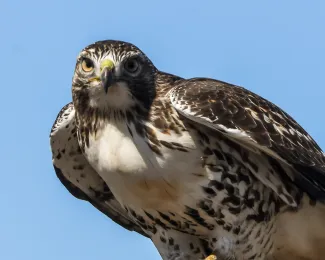
Perhaps the most common of Oklahoma's hawks, the red-tailed hawk is found in our state year-round. This familiar bird has broad wings and adults often show the namesake red tail. But an unrelenting variation of light and dark subspecies, or races, can cause a lot of confusion for hawk-watchers. Look for a a dark belly band and a dark bar on the underside of the wing, seen in flight from the bird’s “shoulder” to "wrist," to help confirm identification of most birds.
While the red-tailed hawk is a year-round residents, Oklahoma’s numbers balloon as birds from more northern states drift south to enjoy our more temperate winters.
Did you know? The red-tailed hawk was named Oklahoma's state raptor in 2018!
Red-shouldered Hawk
Year-round Resident
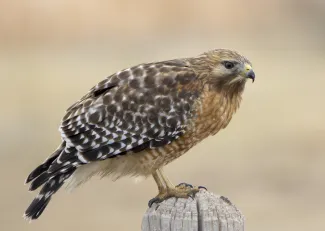
With a shock of rust-colored breast feathers and a shorter, banded tail, the red-shouldered hawk is reasonably easy to distinguish from the larger red-tailed hawk. This resident hawk is frequently spotted perched on power lines and can be found near creeks and rivers in eastern Oklahoma’s wooded habitats.
This vocal bird can be easily heard calling throughout the forest and is regularly imitated by blue jays.
Cooper’s Hawk and Sharp-shinned Hawk
Year-round Resident vs. September – May
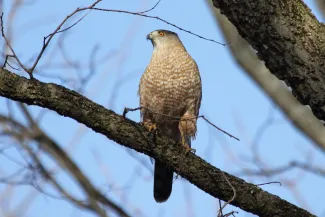
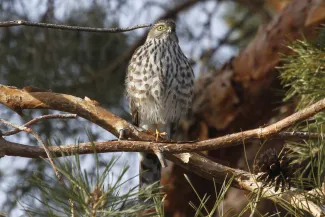
Though differences in size, tail shape, and head coloration separate the Cooper’s hawk from the sharp-shinned hawk, it is a challenge for many bird watchers to tease out these subtle distinctions between these look-alike species.
Both the Cooper’s and sharp-shinned hawk share rounded wings and long, banded tails. Adults of both species have red barring on the breast and intense red eyes. And both are efficient predators of songbirds and can be readily spotted in neighborhoods and treed backyards.
The larger Cooper’s hawk has a larger head in proportion to its body, a dark crown or cap, and a more rounded tail than the smaller sharp-shinned hawk.
This Pairing Deserves a Wild Double Take
Northern Harrier
August – May
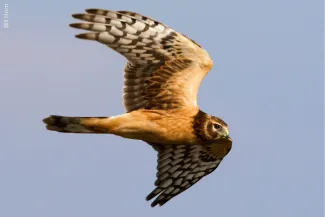
The Northern harrier seems to float over Oklahoma’s prairies and shrublands as it hunts for birds and small rodents, providing a ready clue for identification. Outside of these sweeping flights, several characteristics define the harrier. This bird has an “owlish” face, long wings, a long tail, and a distinct white patch on the “rump” or upper side of the tail.
While the gender of most hawk species is often determined by size, not coloration, it is easy to differentiate a male Northern harrier from a female. Males are gray above with a white belly and wings; wings are tipped with black. Females are dark brown above and buff-colored below.
Ferruginous Hawk
October – March
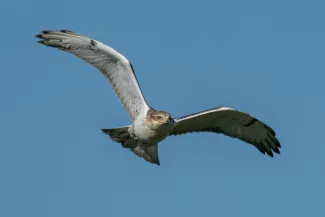
A large hawk of the high plains, the ferruginous hawk can pack into prairie dog towns during the winter. Though a mouthful, the word "ferruginous" refers to the iron-red coloration of the feathers.
Two morphs, or color variations, occur in this species, though most sightings in Oklahoma are of the lighter variety. This bird has a rusty back and rusty feathers that extend down the legs to the feet, also called "leggings," and a white underside speckled with rust. When viewed from above, large crescents mark the rufous wings.
The ferruginous hawk has been documented nesting in Oklahoma’s Panhandle, and can be a winter visitor to the body of the state.
Rough-legged Hawk
October – March
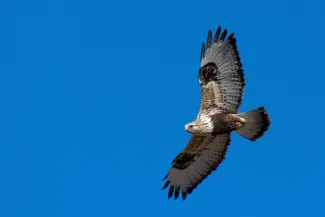
Similar in size to the red-tailed hawk, the rough-legged hawk tends to be darker in color, have feathered legs, and a white tail banded with a dark belt at the end. Light morph birds have a dark center and dark wing tips. These birds often face into the wind while hunting for mice and other rodents.
Hit Upload on Your Hawk Sightings
Take your hawk-watching to the next level by sharing your sightings on free nature-sharing platforms like eBird and iNaturalist! Documenting your sightings not only helps you archive your nature experiences, but can help other bird enthusiasts plan their next trip and help biologists plan their next survey.